
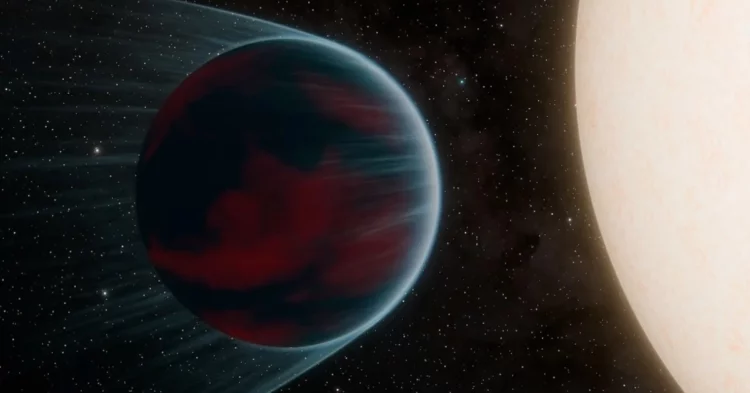
In the vast cosmos beyond our solar system, a cosmic infant named Toi-1227b has captured the attention of astronomers. Discovered in 2022, this gaseous giant is not only one of the youngest exoplanets ever observed, but it is also on the brink of destruction. Locked in a perilously close orbit around a volatile red dwarf star, Toi-1227b is enduring intense radiation that threatens to strip away its atmosphere—and its future.
Table of Contents
A Gaseous Giant Barely Eight Million Years Old
Toi-1227b is a massive planet roughly the size of Jupiter, but only 20% as massive. It orbits an M-class red dwarf star located approximately 330 light-years from Earth. Despite its large size, what sets this planet apart is not its composition, but its youth. At just eight million years old, it is the second youngest exoplanet ever discovered in transit.
Trapped in a Death Spiral: The Hazardous Orbit
Why Red Dwarfs Are So Dangerous
Red dwarfs may appear dim and harmless compared to larger stars, but they are far from benign. These stars are fully convective, meaning their interiors churn continuously, generating powerful magnetic fields. These fields produce immense bursts of energy, releasing strong X-rays and radiation.
Toi-1227b orbits at a dangerously close distance—just one-fifth the distance between Mercury and our Sun—placing it squarely in the line of fire. This proximity exposes the planet to an onslaught of lethal high-energy radiation.
Planet Under Siege: Atmospheric Erosion in Real Time
How Radiation Is Stripping the Planet
Observations using optical spectroscopy and X-ray imaging have confirmed that Toi-1227b is shedding its atmosphere at an alarming rate—approximately one million tons every second. That’s equivalent to losing two Earth-sized atmospheres every 200 years. At this pace, the planet could be stripped nearly bare within a billion years.
The Science of Disappearance
The culprit behind this loss is photoevaporation, a process in which intense radiation heats the atmosphere to such high temperatures that it begins to expand and escape. X-rays ionize and break apart molecules like water, releasing lighter elements such as hydrogen into space. The stellar wind from the star adds momentum, hastening the loss.
A Window Into Planetary Evolution
What This Means for Exoplanet Science
Toi-1227b is more than just a celestial tragedy—it is a scientific treasure. Its current state offers critical clues to how planetary atmospheres form, evolve, and disappear under extreme conditions. According to co-author Alexander Bings, the planet may lose over 10% of its mass depending on its still-uncertain composition and mass.
Solving the “Exoplanet Radius Gap”
Scientists have long puzzled over a missing category of exoplanets: those with sizes between 1.5 and 2 times that of Earth are rare. Toi-1227b could help explain this “radius gap.” The theory is that planets originally formed larger, but radiation from their host stars caused photoevaporation, reducing their size significantly over time.
How Robots and Technology Are Revolutionizing Water and Energy Networks
Quantum Engine Powered Without Gas or Hydrogen Heralds a New Era for Humanity
What’s Next: Continuing the Search for Answers
As the study’s authors explain, Toi-1227b represents a unique testbed for future research. Continued spectroscopic and photometric monitoring is essential to refine estimates of the planet’s mass, atmosphere, and erosion rate. These insights may ultimately reveal the early-life struggles of many planets throughout the galaxy.
Conclusion: A Cosmic Tragedy Unfolding
Toi-1227b is a snapshot of planetary life in its most vulnerable stage. Born too close to a deadly star, it faces an inevitable transformation—if not complete destruction. Yet through this planetary crisis, astronomers may better understand how countless other worlds live and die in the universe.