
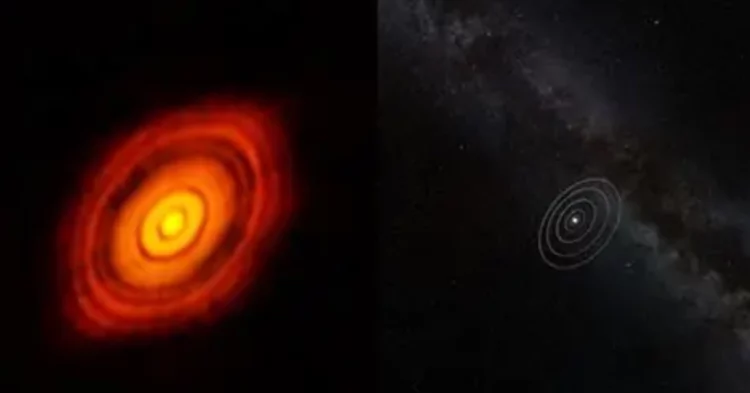
In a monumental stride for astronomy, scientists have witnessed the earliest stage of a solar system’s creation. Using two of the most advanced telescopes ever built—the James Webb Space Telescope (JWST) and the Atacama Large Millimeter/submillimeter Array (ALMA)—researchers captured the formation of solid particles around a young star named HOPS-315, located in the Orion B molecular cloud, 1,300 light-years from Earth.
This rare observation marks the beginning of planetary birth, offering direct evidence of how systems like our own solar system may have formed. The discovery is not just an astronomical milestone—it’s a time machine into the cosmic processes that shaped our origins.
Table of Contents
The Stellar Nursery: What Is HOPS-315?
A Young Star in the Orion B Molecular Cloud
HOPS-315 is a protostar still in its formative stages, embedded within a dense, cold region of interstellar gas and dust. This type of region, known as a stellar nursery, is where new stars and planets are born. For the first time, scientists observed solid silicate particles condensing from hot gas—the very beginning of planetary material forming.
These early solids are believed to be similar to the foundational material that once formed Earth, Mars, and the rest of our solar system’s rocky planets. In essence, researchers have captured what could be considered the “cosmic blueprint” of planet formation.
Cutting-Edge Technology Makes the Invisible Visible
JWST and ALMA: A Revolutionary Combination
The clarity and depth of this discovery would have been impossible without the combined power of the JWST and ALMA. Together, they provided both infrared imaging and high-resolution spectroscopy, allowing scientists to:
- Penetrate dense clouds of gas and dust that usually obscure young stars
- Detect silicon monoxide, a chemical precursor to silicate minerals
- Identify solid mineral formations at distances within the disk comparable to our asteroid belt
This technological synergy allowed scientists to map the mineral composition of the protostellar disk and study the temperature conditions that foster planet formation.
The Earliest Building Blocks of Planets
Discovery of High-Temperature Crystals
One of the most significant findings was the detection of crystalline silicate minerals, such as forsterite and enstatite, embedded within the disk of HOPS-315. These minerals are critical because they only form under extremely high temperatures and are also found in meteorites on Earth—linking the distant star’s formation process to our own solar history.
This discovery supports the existence of a “thermostat region”—a part of the protoplanetary disk where the right balance of heat and pressure allows certain materials to condense into solid form. This is a crucial step in forming the pebbles and rocks that will one day become planets.
TOI-1227b A Newborn Planet Slowly Vaporizing Under Its Star’s X-ray Glare
Quantum Engine Powered Without Gas or Hydrogen Heralds a New Era for Humanity
Peering Into Our Cosmic Past
A Mirror of the Solar System’s Youth
The significance of studying HOPS-315 extends beyond this single star. It acts as a natural laboratory, allowing scientists to compare their findings with models of our solar system’s early development. The presence of key minerals and gases gives vital clues about:
- The chemical evolution of stellar environments
- The role of heat in shaping planetary material
- How planetary systems like ours might emerge across the galaxy
By analyzing the light signatures of these minerals with JWST’s infrared sensors, scientists can reconstruct the physical and chemical environment of early solar systems—effectively unlocking the story of our own creation.
A New Chapter in Planetary Science
The observation of HOPS-315 represents a leap forward in our understanding of planetary formation. For the first time, astronomers can observe, rather than infer, the moment where gas transforms into the first solid ingredients of future planets.
As telescope technology continues to advance, discoveries like this one will only become more frequent—and more detailed. Each one brings us closer to answering some of the most fundamental questions in science: How did we get here? Are there other worlds like ours? What else is being born in the vast darkness of space?
Looking Forward: The Next Frontier in Cosmic Exploration
HOPS-315 is not just a young star with dust around it—it is a cosmic time capsule, showing us how stars and planets like ours are forged from the elemental chaos of the universe. With tools like JWST and ALMA, astronomers are poised to identify many more such systems, bringing the origins of planets—including Earth—into sharper focus.
In the end, the more we learn about distant stars and their newborn disks, the more we come to understand the extraordinary story of our own solar system—and our place in the cosmos.