
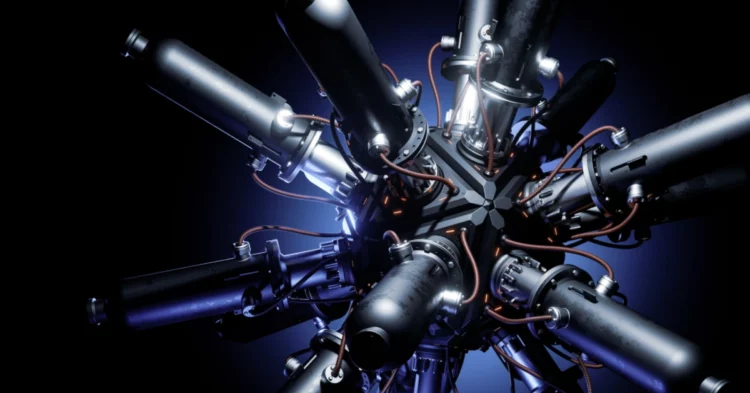
A groundbreaking development by researchers at the Chinese Academy of Sciences has introduced the world’s first operational quantum engine—a device that defies conventional energy systems by functioning without gasoline, hydrogen, or any traditional fuel. Instead, it uses the strange yet powerful phenomenon of quantum entanglement to generate mechanical force.
This innovation could mark a historic turning point in energy science, potentially redefining how we power machines, computers, and even spacecraft.
Table of Contents
The Breakthrough: Energy from “Spooky Action at a Distance”
Historic Test Demonstrates First Entanglement-Powered Engine
The scientific world was stunned when a Chinese research team successfully demonstrated the first-ever quantum engine powered entirely by entangled particles. This engine manipulates particles using highly calibrated laser systems, converting subatomic behaviors into tangible mechanical energy.
“This breakthrough demonstrates practical applications of quantum mechanics in energy generation,” said Dr. Li Wei, lead physicist on the project. It’s a new way of thinking about energy—not as something consumed and depleted, but as something extracted from the very laws of physics.
How It Works: Breaking Down the Quantum Engine
Step-by-Step Mechanics of a Fuel-Free Power Source
Rather than relying on combustion or chemical reactions, the quantum engine uses particles cooled to near absolute zero and trapped inside specialized ion cages. Here’s how it works:
- Ion Traps stabilize and isolate individual particles.
- Precision Lasers control the quantum states and stimulate motion.
- Advanced Cooling Systems maintain near-zero temperatures for quantum stability.
- Quantum Sensors monitor the level and quality of particle entanglement.
When laser pulses hit the trapped ions, they generate coordinated vibrations via entanglement—a process that converts quantum activity into usable motion.
Quantum Entanglement: The Science Behind the Magic
What Is Entanglement, and Why Does It Matter?
Quantum entanglement refers to a unique phenomenon where two or more particles become linked, so that the state of one instantly affects the other—regardless of distance. Einstein famously described it as “spooky action at a distance.”
In over 10,000 laboratory tests, the research team confirmed that greater entanglement levels led to significantly increased mechanical output. This correlation confirms entanglement can be a viable alternative energy source—a dramatic departure from fossil fuels and chemical batteries.
Real-World Applications: What Quantum Engines Could Power
Beyond Theory: Where This Technology May Take Us
The implications of quantum engine technology reach far beyond physics labs. Here are some of the practical uses scientists are currently exploring:
| Potential Application | Expected Benefit | Timeline to Deployment |
|---|---|---|
| Quantum Computing | Self-sustaining computers with no external power | 5–7 years |
| Medical Nanodevices | Microscopic motors for targeted drug delivery | 8–10 years |
| Deep Space Propulsion | Lightweight, long-lasting spacecraft engines | 15–20 years |
What Needs to Happen Next
- Improve entanglement quality for higher efficiency
- Develop room-temperature quantum engines
- Scale devices for public and commercial use
- Integrate with existing energy infrastructure
Global Implications: A Quantum-Powered Society?
Opportunities and Challenges on the Road Ahead
Quantum engines promise a future where energy scarcity may become obsolete. However, challenges remain:
- Quantum Coherence: Maintaining stable entanglement at larger scales is difficult outside lab conditions.
- Material Limitations: New materials are needed to support entangled states in real-world environments.
- Ethical Considerations: Who controls the technology? Will it be widely accessible, or limited to global superpowers?
Dr. Maria Gonzalez from MIT notes, “If scaled correctly, quantum engines could change not just energy, but global economics, environmental policy, and even our approach to climate change.”
The Future Starts Now: Moving from Theory to Reality
The quantum engine isn’t just a technological novelty—it may mark the beginning of a post-fuel era. While practical use may still be years away, the foundation has been laid for energy systems powered not by combustion or chemical reaction, but by the fabric of reality itself.
As research continues in China and around the world, the idea of a quantum-powered civilization is shifting from science fiction to science fact—offering humanity a cleaner, more efficient, and perhaps limitless energy future.