
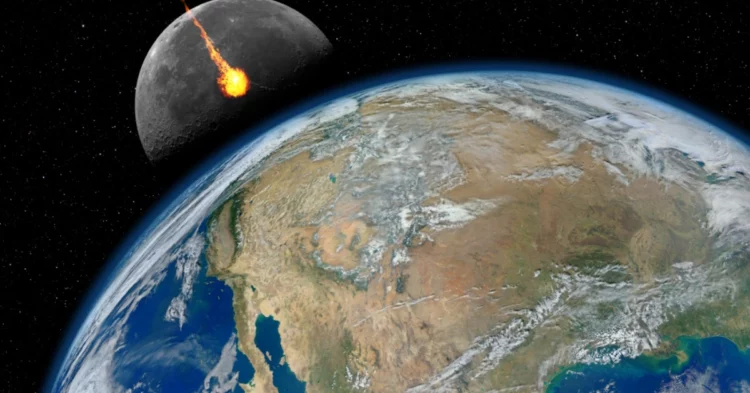
A newly discovered asteroid—2024 YR4—may light up the skies in 2032 with an otherworldly display. But beneath the beauty of a potential global meteor shower lies a darker side: the serious risk to Earth’s satellites and orbital infrastructure. Though the asteroid no longer threatens Earth directly, it may be on a collision course with the Moon, and that possibility has scientists closely watching.
Table of Contents
Discovered Just in Time: A Close Call with a “City-Killer” Asteroid
First spotted in December 2024, 2024 YR4 measures roughly 200 feet wide—large enough to obliterate an entire city if it collided with Earth. Initial data suggested a 3.1% chance of an Earth impact on December 22, 2032. That may seem small, but in the world of space monitoring, it was enough to sound the alarms at NASA.
Subsequent calculations thankfully ruled out any danger to Earth. But while Earth is safe, the Moon may not be so lucky.
New Trajectory Points to a Lunar Collision
Since April 2025, attention has shifted to a different possibility: a direct strike on the Moon. The chance of impact has climbed slightly, from 3.8% to 4.3%, as astronomers refine their tracking of the asteroid’s path. More accurate projections will arrive during 2028’s close flyby.
If 2024 YR4 does hit the Moon, the event could have dramatic consequences—not just for science, but for Earth’s growing orbital ecosystem.
What Happens if the Asteroid Hits the Moon?
Simulations by researchers at the University of Western Ontario suggest that a lunar impact could eject up to 220 million pounds of rock into space. If the impact occurs on the Moon’s Earth-facing side, about 10% of that debris might fall into Earth’s gravitational field.
That debris could create a days-long meteor storm visible around the globe—a dazzling, once-in-a-millennium spectacle. But behind the beauty lies danger.
The Double-Edged Sword: A Celestial Light Show with Serious Risks
While the sight of a fiery sky might captivate stargazers, the fragments could wreak havoc on orbiting satellites. Even a one-centimeter rock traveling at 20,000 mph can act like a bullet in space, capable of disabling critical satellites or even endangering crewed missions.
By 2032, the Earth’s orbit will be far more crowded, with tens of thousands of satellites supporting global internet, navigation, weather forecasting, and defense systems. If debris from the Moon impact spreads unpredictably, scientists estimate that the chances of satellite collisions could increase 1,000-fold.
The Tiangong and Other Orbiting Stations at Risk
The Chinese Tiangong space station, along with other low-Earth-orbit platforms, could be particularly vulnerable. A fragment from the Moon traveling at cosmic speeds could pierce vital systems or force emergency evasive maneuvers.
This potential event raises the stakes for better protection and resilience in space infrastructure.
A Unique Chance to Test Planetary Defense—But at What Risk?
There’s another layer to this story: some scientists see 2024 YR4 as a perfect target for testing asteroid deflection technologies. Much like NASA’s 2022 DART mission, which nudged the asteroid Dimorphos off course, a mission to divert 2024 YR4 could showcase our ability to protect the planet.
However, experts like Paul Wiegert warn of the dangers. A poorly executed deflection attempt could redirect the asteroid toward Earth instead of away, turning a low-risk Moon strike into a global disaster. The margin for error is razor-thin.
A Wake-Up Call from the Cosmos
Even if 2024 YR4 never touches the Moon, its presence is a powerful reminder: our planetary defense strategies must evolve. The skies of 2032 might hold one of the most breathtaking events in living memory—but they could also test our ability to respond to unexpected space hazards.