
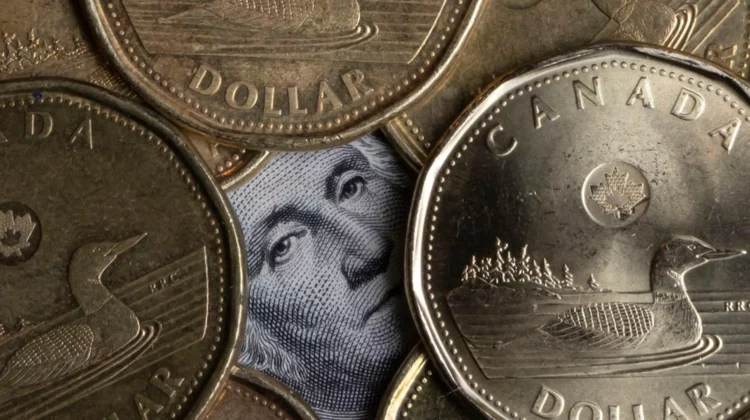
The Canadian dollar climbed to its strongest level in nearly seven weeks against the U.S. dollar on Monday, supported by a combination of easing geopolitical tensions, rising oil prices, and shifting expectations around major central bank policy decisions scheduled for later in the week.
The currency, often referred to as the loonie, advanced as global investors leaned into risk-positive sentiment amid growing optimism that diplomatic efforts could help reduce tensions in the Middle East. At the same time, markets were positioning themselves ahead of key monetary policy announcements from the Bank of Canada and the Federal Reserve.
By Monday’s close, the Canadian dollar was up approximately 0.4 percent at 1.3615 per U.S. dollar, equivalent to 73.45 U.S. cents. Earlier in the session, it touched 1.3598, marking its strongest intraday level since March 12.
This move reflects a broader shift in sentiment where commodity-linked currencies are benefiting from both energy market strength and a softer U.S. dollar outlook.
Geopolitical Developments Fuel Market Optimism
Diplomatic Signals Between the United States and Iran
A key driver of improved risk appetite has been renewed speculation around diplomatic engagement in the Middle East. According to sources in Pakistan, which is reportedly acting as a mediator, efforts have not stalled in bridging communication gaps between the United States and Iran.
While no formal breakthrough has been announced, the continuation of dialogue has been enough to ease immediate fears of escalation. Markets tend to react quickly to any indication that geopolitical risks may be contained, especially in regions tied to global energy supply routes.
The Strait of Hormuz, one of the world’s most critical oil transit chokepoints, remains a focal point for traders. Any disruption in this region historically leads to sharp increases in oil prices and broader volatility in currency markets.
For now, the perception that tensions are being managed has contributed to a supportive environment for risk-sensitive assets, including the Canadian dollar.
Oil Prices Reinforce Strength in Commodity-Linked Currencies
Crude Oil Rally Supports the Loonie
Oil prices rose around 2 percent to 96.29 U.S. dollars per barrel, reflecting concerns about constrained supply flows. Shipments through the Strait of Hormuz remain limited, tightening global energy markets and pushing prices higher.
Canada, as one of the world’s largest oil exporters, is particularly sensitive to movements in crude oil prices. Higher oil prices typically translate into stronger export revenues, improved trade balances, and increased foreign demand for Canadian dollars.
This relationship between oil and the currency continues to be a central pillar of CAD valuation. As energy prices climb, investors often increase exposure to commodity-linked currencies such as the Canadian dollar, Australian dollar, and Norwegian krone.
Sarah Ying, head of foreign exchange strategy at CIBC Capital Markets, noted that the combination of geopolitical de-escalation hopes and higher oil prices has created a favorable backdrop for the Canadian currency.
She explained that elevated oil prices are currently acting as a tailwind for commodity currencies, especially as geopolitical risks, while still present, remain contained compared to earlier expectations.
Central Banks Take Center Stage This Week
Bank of Canada Expected to Hold Rates Steady
Attention in currency markets is now shifting toward monetary policy decisions expected this week from both the Bank of Canada and the Federal Reserve.
The Bank of Canada is widely expected to maintain its benchmark interest rate at 2.25 percent on Wednesday. Economists believe that recent oil price increases, while notable, are likely to be viewed as a temporary shock rather than a sustained inflation driver.
This interpretation reduces pressure on the central bank to tighten policy further in the short term. Instead, policymakers are expected to maintain a cautious and data-dependent stance, particularly as inflation expectations remain relatively anchored.
A stable interest rate environment typically reduces volatility in currency markets and allows external factors such as commodity prices and global risk sentiment to play a larger role in determining currency direction.
Federal Reserve Policy Outlook Adds Additional Complexity
At the same time, the Federal Reserve is also expected to keep its policy stance unchanged during its Wednesday meeting. However, market participants are increasingly focused on the tone of the Fed’s communication rather than the rate decision itself.
Expectations are building for a potentially more dovish tone from the U.S. central bank, especially as economic data in the United States shows signs of moderation.
If the Federal Reserve signals a more cautious approach toward future tightening, it could place downward pressure on the U.S. dollar, indirectly supporting further gains in the Canadian dollar.
Currency Market Positioning Shows Reduced Bearish Sentiment
Speculators Scale Back Negative Bets on the Loonie
Recent data from the U.S. Commodity Futures Trading Commission indicates a notable shift in investor positioning. Non-commercial traders reduced their bearish bets on the Canadian dollar in the week ending April 21.
Net short positions declined to 58,834 contracts from 78,272 the previous week. This reduction suggests that market participants are becoming less pessimistic about the currency’s near-term outlook.
Such positioning shifts often amplify currency movements when combined with macroeconomic catalysts such as oil price changes or central bank decisions.
The decline in bearish positioning reflects growing confidence that the Canadian dollar may have more room to strengthen, particularly if global risk conditions remain stable.
Fiscal Developments Add Another Layer of Market Focus
Canada Announces Sovereign Wealth Fund Initiative
In addition to monetary and geopolitical developments, fiscal policy has also entered the spotlight. Prime Minister Mark Carney has announced plans to establish a sovereign wealth fund with an initial endowment of 25 billion Canadian dollars, equivalent to approximately 18.38 billion U.S. dollars.
The fund is expected to focus on investing in major domestic projects, potentially supporting long-term economic development and infrastructure growth.
While the immediate market impact of the announcement is limited, investors are closely monitoring fiscal policy direction as it may influence future borrowing requirements, investment flows, and overall economic stability.
Large-scale sovereign investment initiatives are often interpreted as signals of long-term strategic planning, which can contribute to investor confidence in a country’s economic outlook.
Bond Markets Reflect Shifting Rate Expectations
Canadian Yields Edge Higher
In fixed income markets, Canadian government bond yields moved slightly higher, with the 10-year yield rising by 3.6 basis points to 3.499 percent.
Rising yields can reflect a range of factors including inflation expectations, global risk sentiment, and shifts in interest rate forecasts. In this case, the move appears consistent with broader market anticipation of central bank communication rather than immediate inflation concerns.
Higher yields can also support currency strength by increasing returns on domestic assets, making Canadian investments more attractive to foreign capital.
Market Outlook: Key Drivers for the Canadian Dollar
Oil Prices and Geopolitical Stability
The most immediate driver for the Canadian dollar remains the direction of oil prices. Sustained strength in crude markets would likely continue to support the currency, particularly if supply constraints persist in key transit routes such as the Strait of Hormuz.
However, any sudden resolution or de-escalation in geopolitical tensions that reduces energy risk premiums could limit further gains in oil and, by extension, the Canadian dollar.
Interest Rate Divergence Between Canada and the United States
Another critical factor is the relative policy stance between the Bank of Canada and the Federal Reserve. If the U.S. central bank signals a more accommodative stance compared to a neutral Canadian policy outlook, the resulting interest rate divergence could favor the Canadian dollar.
Currency markets often respond strongly to such differentials, as they influence capital flows and yield-seeking behavior among global investors.
Investor Sentiment and Risk Appetite
Broader global sentiment remains a key variable. The Canadian dollar typically performs well in environments where investors are comfortable taking on risk, particularly when equity markets are stable and geopolitical tensions are contained.
Any return to risk aversion could quickly reverse recent gains, highlighting the sensitivity of the currency to global market psychology.
Conclusion: A Currency Supported by Converging Positive Forces
The recent rise in the Canadian dollar reflects a convergence of supportive macroeconomic and geopolitical factors. Easing fears of escalation in the Middle East, stronger oil prices, and shifting expectations around central bank policy have collectively created a favorable environment for the loonie.
While short-term momentum remains positive, the outlook is still highly dependent on external developments, particularly in energy markets and global interest rate policy.