
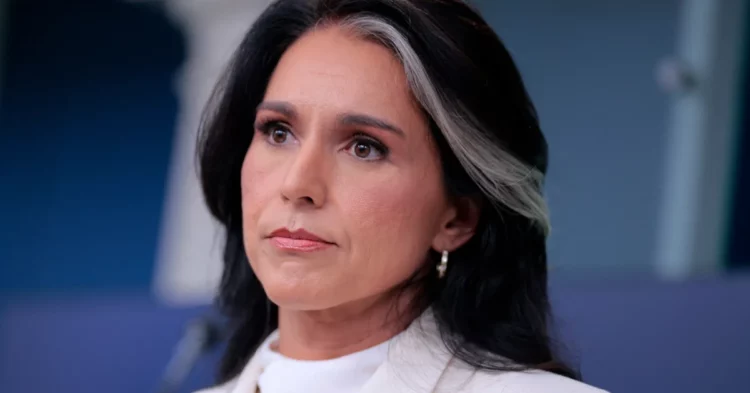
Director of National Intelligence Tulsi Gabbard announced that she will step down from her position at the end of June 2026, citing a deeply personal family crisis involving her husband’s health. The announcement marked a dramatic turning point for one of the most unconventional and controversial political figures in recent American politics.
In a resignation letter addressed to President Donald Trump, Gabbard revealed that her husband, Abraham Williams, had been diagnosed with an extremely rare form of bone cancer. She explained that the severity of his condition and the demanding nature of her national security role made it impossible for her to continue serving while also supporting her family during the difficult months ahead.
Her departure comes after months of mounting speculation about her standing within the administration, internal disagreements over foreign policy, and controversies surrounding election investigations and intelligence operations.
A Personal Crisis Behind the Decision
In her letter, Gabbard described the emotional weight behind her resignation and emphasized the importance of standing beside her husband during his treatment.
She wrote that Abraham Williams had been her strongest supporter throughout their marriage, standing by her side during military deployments, political campaigns, and her time in government service. According to Gabbard, she could not continue in such a demanding leadership role while asking him to confront a life-threatening illness alone.
The announcement immediately drew sympathy from political allies and critics alike. President Trump publicly praised Gabbard’s service and said her decision was understandable given the circumstances surrounding her husband’s diagnosis.
Trump also confirmed that Principal Deputy Director of National Intelligence Aaron Lukas would become acting director following Gabbard’s departure.
The president described Gabbard as someone who had performed “an incredible job” while serving in one of the government’s most sensitive national security positions.
White House Rumors Had Been Growing for Weeks
Although the official reason for Gabbard’s resignation centered on family matters, reports from inside the administration indicated that rumors about her possible departure had circulated for several weeks.
Senior administration officials reportedly heard speculation that Gabbard was considering leaving the administration long before the public announcement. Despite those rumors, she had continued denying any plans to resign as recently as two weeks earlier.
According to sources familiar with the matter, Gabbard personally met with Trump in the Oval Office on Friday to hand over her resignation letter.
The suddenness of the announcement fueled renewed discussion about whether personal reasons were the only factor behind her decision to step away from the administration.
A Tumultuous Tenure as Director of National Intelligence
Gabbard’s time leading the U.S. intelligence community was marked by repeated controversies, internal conflicts, and disagreements over America’s military posture abroad.
As director of national intelligence, she oversaw the nation’s 18 intelligence agencies and was responsible for coordinating intelligence assessments on major global threats. However, her messaging on Iran and military intervention frequently appeared to conflict with the White House narrative.
Her critics argued that she often undermined administration messaging by publicly expressing skepticism about military escalation. Supporters, however, viewed her as an independent thinker willing to challenge hawkish foreign policy decisions.
Those tensions became especially visible during the escalating conflict involving Iran.
Disagreements Over Iran Deepened Divisions Inside the Administration
One of the defining controversies of Gabbard’s tenure involved her comments and intelligence assessments regarding Iran’s nuclear capabilities and the U.S.-Israel military campaign.
Months before the conflict intensified, Gabbard reportedly frustrated senior White House officials with statements that were viewed as inconsistent with the administration’s strategy.
The tension reached a peak when she released a video warning that the world was approaching the “brink of nuclear annihilation” and criticizing political leaders she described as “warmongers” for escalating tensions between nuclear powers.
Many within the administration interpreted the message as indirect criticism of Trump’s consideration of military action involving Iran.
The disagreement became public when Trump openly dismissed Gabbard’s congressional testimony that Iran was not actively pursuing a nuclear weapon. Responding to reporters, Trump bluntly stated that he did not care what Gabbard had said and believed Iran was very close to developing nuclear capability.
That public rebuke represented a rare moment in which a sitting president directly contradicted his own intelligence chief in front of the media.
Operation Midnight Hammer Became a Flashpoint
The divide between Gabbard and the administration widened further after the U.S. military operation known as Operation Midnight Hammer.
The military campaign targeted Iranian nuclear facilities and was presented by administration officials as a necessary step to eliminate an imminent threat.
However, in later testimony before the Senate Intelligence Committee, Gabbard stated that Iran’s nuclear enrichment program had effectively been obliterated by the strikes and that intelligence agencies had seen no evidence of reconstruction efforts afterward.
Her prepared remarks contradicted broader administration efforts to justify continued military pressure by claiming Iran remained an active and immediate danger.
Interestingly, Gabbard did not read that specific section aloud during her congressional testimony. When questioned afterward, she explained that time constraints prevented her from reading the entire statement but confirmed that the intelligence assessment remained accurate.
Her comments reignited criticism from both Democrats and Republicans about the administration’s handling of intelligence surrounding the conflict.
Refusal to Define an “Imminent Threat” Sparked Debate
During congressional hearings, Gabbard also faced sharp questioning over whether Iran posed an imminent threat to the United States.
Rather than directly answering, she stated that determining what constitutes a threat was ultimately the responsibility of the president, not the intelligence community.
The response triggered immediate criticism from lawmakers and former intelligence officials, many of whom argued that assessing threats is one of the intelligence community’s primary responsibilities.
Her cautious language appeared designed to avoid directly contradicting the White House while also avoiding endorsement of claims she may not have fully supported.
The balancing act only intensified perceptions that Gabbard was increasingly isolated within the administration.
Counterterrorism Official’s Resignation Added More Pressure
Complicating matters further, Gabbard’s top counterterrorism official, Joe Kent, resigned shortly after the conflict with Iran escalated.
Kent reportedly expressed concerns that Iran did not represent an imminent threat and questioned the justification for military involvement.
Although Kent’s resignation amplified scrutiny of the administration’s strategy, Gabbard publicly distanced herself from his comments during later congressional hearings.
When lawmakers asked whether she found his remarks concerning, she answered affirmatively.
That response surprised some observers who believed Gabbard privately shared similar reservations regarding military escalation.
Fulton County Election Investigation Became Another Major Controversy
In addition to foreign policy disputes, Gabbard also became deeply involved in investigations related to alleged voter fraud in the 2020 presidential election.
One of the most controversial episodes occurred when she personally appeared in Fulton County, Georgia, during an FBI search connected to election-related investigations.
The search centered on efforts by the Justice Department to obtain voting data and examine allegations of election irregularities.
Critics immediately questioned why the director of national intelligence was participating in what appeared to be a domestic law enforcement matter.
Traditionally, the Office of the Director of National Intelligence focuses on foreign intelligence coordination rather than internal election investigations.
Several former intelligence officials warned that Gabbard’s presence risked blurring the line between domestic law enforcement and national intelligence operations, a distinction strengthened after the Watergate era to prevent abuses of power.
Confusion Over Who Authorized Her Role
The controversy intensified when conflicting explanations emerged regarding who requested Gabbard’s involvement in Fulton County.
In communications with congressional intelligence committees, Gabbard stated that her participation had been requested directly by President Trump.
However, other administration officials reportedly provided different explanations, leading to confusion about the chain of authority behind her presence.
The incident fueled accusations that intelligence agencies were becoming increasingly politicized under the administration.
Election law experts also questioned whether Gabbard had any legal authority to oversee or participate in the operation.
The backlash further complicated her already fragile relationship with some members of Congress and segments of the intelligence community.
Puerto Rico Voting Machine Investigation Raised Eyebrows
Gabbard’s office also faced criticism after obtaining voting machines from Puerto Rico as part of broader investigations into election security vulnerabilities.
The Office of the Director of National Intelligence later released statements highlighting concerns about potential security flaws in the systems.
However, election security experts noted that many of the vulnerabilities cited were already well-known and had previously been addressed through existing safeguards and updates.
Critics accused the administration of reviving disproven election concerns to reinforce Trump’s longstanding claims that the 2020 election had been stolen.
Supporters argued that reviewing election infrastructure remained a legitimate national security concern.
The issue became another example of Gabbard operating at the center of politically explosive controversies.
From Democratic Presidential Candidate to Trump Ally
Gabbard’s political evolution remains one of the most remarkable transformations in modern American politics.
A former Democratic congresswoman from Hawaii, she first gained national attention as a military veteran with strong anti-interventionist views.
Representing Hawaii’s 2nd Congressional District, she made history as the first American Samoan and the first practicing Hindu elected to Congress.
Her 2020 Democratic presidential campaign focused heavily on opposition to foreign wars and criticism of the political establishment.
Although her campaign struggled to gain traction nationally, she built a loyal following among voters frustrated with traditional party politics.
Over time, however, her relationship with the Democratic Party deteriorated sharply.
Leaving the Democratic Party and Joining Republicans
In 2022, Gabbard officially left the Democratic Party, accusing party leaders of promoting divisive politics and suppressing dissenting voices.
Her shift toward conservative politics accelerated in the years that followed.
By the 2024 presidential election, Gabbard had become one of Trump’s most visible allies, campaigning alongside him and assisting with debate preparation against then-Vice President Kamala Harris.
She formally joined the Republican Party before the election and later served on Trump’s transition team after his victory.
Trump eventually selected her to lead the nation’s intelligence community despite skepticism from some lawmakers and former intelligence officials.
Her appointment was viewed as one of the administration’s most unconventional national security decisions.
Questions About Her Legacy Remain Unanswered
As Gabbard prepares to leave office, analysts remain divided over how history will judge her tenure.
Supporters argue that she challenged entrenched intelligence bureaucracy, promoted transparency, and resisted pressure for broader military intervention.
Critics contend that her leadership weakened confidence in the intelligence community and blurred critical boundaries between politics, domestic investigations, and national security operations.
Her resignation now leaves the administration facing another major personnel shakeup at a time of ongoing geopolitical uncertainty and domestic political division.
Whether remembered as an independent reformer or a deeply polarizing figure, Tulsi Gabbard’s time as director of national intelligence will likely remain one of the most debated chapters of the Trump administration’s national security legacy.
The Human Side of a Political Exit
Despite the political controversies surrounding her departure, the central reason behind Gabbard’s resignation remains deeply personal.
Her decision underscores how even the highest-ranking government officials are ultimately confronted by the realities of family, illness, and personal responsibility.
For now, attention has shifted away from political strategy and toward Abraham Williams’ health battle and the difficult journey facing the couple in the months ahead.