
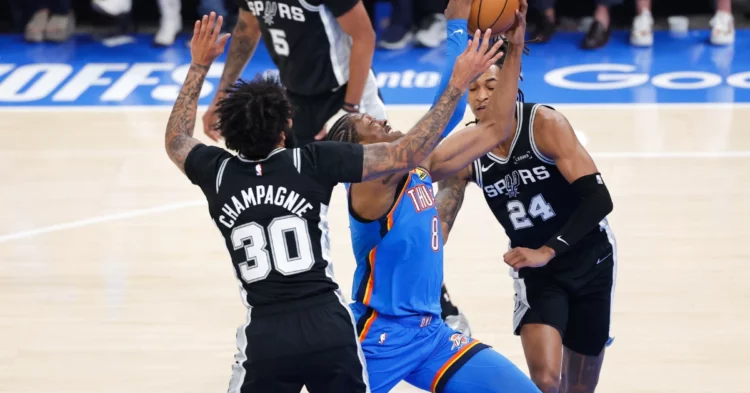
The 2026 Western Conference Finals have quickly evolved into everything basketball fans hoped they would be: a fierce showdown between two powerhouse teams led by generational superstars. On one side stands Oklahoma City Thunder MVP candidate Shai Gilgeous-Alexander, whose smooth scoring and calm leadership continue to define the Thunder’s championship ambitions. On the other side is San Antonio Spurs phenom Victor Wembanyama, whose historic production is putting him in conversations reserved for the game’s greatest legends.
After two games, the series is tied 1-1 as it heads to San Antonio for a pivotal Game 3. While the spotlight naturally shines on Gilgeous-Alexander and Wembanyama, the real story of this series may ultimately come down to something less glamorous but equally important: depth, durability, and which supporting cast can survive the physical toll of playoff basketball.
The stars are delivering spectacular performances. The question now is whether their teammates can keep up long enough to help them reach the NBA Finals.
Victor Wembanyama Is Producing Historic Western Conference Finals Numbers
Victor Wembanyama entered the postseason carrying enormous expectations, and so far, he has exceeded every one of them. Through the first two games of the Western Conference Finals, the Spurs superstar has already accumulated 62 points and 41 rebounds, numbers rarely seen at this stage of the playoffs.
In Game 1, Wembanyama completely overwhelmed Oklahoma City with a staggering 41-point, 24-rebound masterpiece that instantly became one of the defining performances of the postseason. His combination of length, shot-making, rim protection, and rebounding created matchup nightmares the Thunder struggled to solve.
The achievement placed Wembanyama in elite historical company. No player since Kareem Abdul-Jabbar in 1974 has recorded at least 60 points and 40 rebounds through the first two games of a conference finals series. For a 22-year-old superstar still early in his career, the accomplishment only reinforces the growing belief that he may already be one of the NBA’s most dominant forces.
What makes Wembanyama especially dangerous is his versatility. He can score inside, stretch defenses with perimeter shooting, alter nearly every shot near the basket, and dominate the glass simultaneously. Oklahoma City has tried multiple defensive looks against him, yet none have consistently slowed him down.
Despite his brilliance, Wembanyama remains focused on improvement rather than individual numbers. Following Game 2, he openly acknowledged missed opportunities late in the contest, showing the maturity and self-awareness that have made him the centerpiece of San Antonio’s long-term future.
His mentality reflects the Spurs’ overall confidence heading back home. San Antonio already accomplished one major objective by stealing a road victory in Oklahoma City. Now, with home-court energy behind them, the Spurs believe the momentum could quickly shift in their favor.
Shai Gilgeous-Alexander Responds After Another Slow Game 1
While Wembanyama exploded early in the series, Shai Gilgeous-Alexander experienced a familiar problem.
For much of his playoff career, Game 1 struggles have oddly become a pattern. In the series opener against San Antonio, Gilgeous-Alexander shot just 7-for-23 from the field, continuing a trend that has seen him fail to shoot above 50 percent in six of his last seven Game 1 appearances.
However, the Thunder superstar wasted little time correcting course.
In Game 2, Gilgeous-Alexander looked fully re-energized, pouring in 30 points and controlling the pace throughout Oklahoma City’s victory. His mid-range game returned, his drives became more aggressive, and his decision-making stabilized the Thunder offense.
Rather than expressing concern over the Game 1 struggles, Gilgeous-Alexander offered a simple explanation. He believes long breaks between playoff rounds tend to disrupt his rhythm. Once he settles back into competitive action, his offensive flow usually returns quickly.
That explanation certainly matched what unfolded in Game 2.
When Gilgeous-Alexander attacks confidently, Oklahoma City becomes one of the league’s toughest teams to defend. His ability to create shots from nearly every area of the floor forces defenses into impossible decisions. If defenders press too tightly, he drives to the rim. If they sag off, he punishes them with pull-up jumpers.
More importantly, his composure spreads throughout the Thunder roster. Oklahoma City plays with greater pace, confidence, and defensive intensity when its leader is operating at full strength.
As the series shifts to San Antonio, the Thunder will need another elite performance from Gilgeous-Alexander to regain control of home-court advantage.
Injuries and Fatigue Are Becoming the Biggest Opponents
While the basketball itself has been spectacular, the physical condition of both rosters is becoming impossible to ignore.
At this stage of the season, every team is battling exhaustion and injuries accumulated over months of intense competition. This series is no exception.
San Antonio guard De’Aaron Fox continues to play through a lingering ankle issue that likely will not fully heal until the offseason. Meanwhile, rookie guard Dylan Harper appeared to aggravate a hamstring injury during Game 2, forcing him to leave early.
The Thunder are facing similar concerns. Jalen Williams aggravated his troublesome left hamstring in Game 2, while reserve guard Ajay Mitchell absorbed a painful thigh shot late in the game.
These injuries may not dominate headlines like the superstar performances, but they could ultimately determine the outcome of the series.
Playoff basketball often becomes a war of attrition. Teams are forced to rely on role players, bench depth, and mental toughness as fatigue builds deeper into May and June. Every rotation decision becomes magnified, especially when key contributors are less than fully healthy.
Spurs coach Mitch Johnson emphasized the importance of depth and readiness, noting that players throughout the roster must be prepared to deliver meaningful minutes whenever called upon.
That challenge becomes increasingly difficult against elite opponents. Every weakness is targeted. Every defensive lapse is punished. Every possession matters.
The team that best manages its physical limitations may gain the edge in the closing games of this tightly contested series.
The Supporting Cast Could Decide the NBA Finals Race
Although Gilgeous-Alexander and Wembanyama dominate headlines, the Western Conference Finals may ultimately hinge on secondary contributors.
Game 1 provided a perfect example. With injuries affecting San Antonio’s rotation, Dylan Harper stepped up in a major way and helped stabilize the Spurs offense. His energy and aggressiveness gave San Antonio critical production beyond Wembanyama’s dominance.
In Game 2, Oklahoma City responded with a key contribution from Isaiah Hartenstein. The veteran center delivered 10 points and 13 rebounds while bringing a level of physicality the Thunder desperately needed.
Hartenstein’s impact extended beyond the stat sheet. His rebounding limited second-chance opportunities for San Antonio, and his toughness helped Oklahoma City establish greater control in the paint.
Role players often become the hidden difference-makers during playoff runs. Opposing defenses naturally focus most of their attention on star players, leaving complementary pieces with opportunities to influence games.
The Spurs and Thunder both understand this reality.
For San Antonio, players like Stephon Castle must continue contributing aggressively while limiting mistakes. Castle produced a memorable highlight dunk over Hartenstein in Game 2, but turnovers remain a major concern. He committed 20 turnovers across the first two games, an unsustainable number against a disciplined Thunder defense.
Oklahoma City coach Mark Daigneault made it clear that aggression is necessary against the Thunder, but reckless play will be punished quickly.
That balance between confidence and control may become one of the defining themes of the series moving forward.
The Statistical Battle Shows How Even the Series Really Is
Few playoff matchups have been this evenly contested statistically.
Through two games, nearly every major category reflects just how balanced these teams are.
Both victories ended with the winning team scoring exactly 122 points. Oklahoma City holds only a slim 237-235 total scoring advantage in the series. The Thunder have made 30 three-pointers compared to San Antonio’s 29.
Even the momentum swings have mirrored one another. Both teams produced an 8-0 run in Game 1 and an 11-0 run in Game 2.
The margins separating these teams remain incredibly thin.
San Antonio has dominated the rebounding battle, collecting 25 more rebounds than Oklahoma City across the opening two games. However, the Spurs have also committed 19 more turnovers, often giving away valuable possessions at critical moments.
Those extra mistakes may become increasingly costly as the series intensifies.
Championship-level basketball often comes down to execution in small moments. A careless turnover, missed rebound assignment, or defensive lapse can swing an entire game. Both teams have shown stretches of brilliance, but neither side has managed to establish consistent control.
That uncertainty is precisely what makes this series so compelling.
Why Game 3 Could Become the Turning Point of the Series
Historically, Game 3s in tied playoff series carry enormous significance. The winner gains not only a series advantage but also a psychological edge that can shape the remainder of the matchup.
For the Spurs, Game 3 represents an opportunity to capitalize on home-court energy and reinforce the momentum generated by Wembanyama’s dominance. San Antonio’s young roster feeds off crowd intensity, and the atmosphere inside the arena is expected to be electric.
Stephon Castle expressed confidence that the Spurs would feel more comfortable returning home after already stealing one game in Oklahoma City.
For the Thunder, however, Game 3 is equally critical.
Defending champions understand how difficult playoff road environments can become once momentum shifts. Oklahoma City cannot afford to let San Antonio build confidence behind its home crowd, especially with Wembanyama playing at a historic level.
The Thunder also recognize that playoff experience matters. Their championship pedigree gives them an advantage in pressure situations, particularly late in games where execution becomes vital.
Expect defensive intensity to rise dramatically in Game 3. Expect every possession to carry greater urgency. And expect the stars to once again shoulder enormous responsibility.
Shai Gilgeous-Alexander vs Victor Wembanyama Is Becoming the NBA’s Next Great Rivalry
Beyond the immediate stakes of the Western Conference Finals, this series may represent the beginning of a rivalry that defines the NBA’s future.
Shai Gilgeous-Alexander is already one of the league’s premier guards, combining elite scoring efficiency with calm leadership and defensive versatility. Wembanyama, meanwhile, appears capable of becoming the NBA’s next transformational superstar.
Their contrasting styles make the matchup especially fascinating.
Gilgeous-Alexander controls games with patience, footwork, and precision. Wembanyama overwhelms opponents with length, athleticism, and seemingly limitless versatility. One dominates from the perimeter, while the other impacts every inch of the court.
Both players also elevate their teammates in different ways. Gilgeous-Alexander stabilizes Oklahoma City’s offense through composure and decision-making. Wembanyama changes entire defensive schemes simply through his presence.
As long as these two stars remain healthy, there is a strong possibility that Thunder vs Spurs becomes the Western Conference’s defining rivalry for years to come.
Conclusion: Depth, Health, and Composure Will Decide This Series
The opening games of the Western Conference Finals have already delivered unforgettable performances, historic statistics, and dramatic momentum swings. Victor Wembanyama has looked unstoppable at times, while Shai Gilgeous-Alexander reminded everyone in Game 2 why he remains one of basketball’s most complete stars.
Yet despite the brilliance of both superstars, the series may ultimately be decided elsewhere.
Health concerns are mounting. Bench players are being forced into larger roles. Turnovers, rebounding, and defensive discipline are becoming increasingly important.