
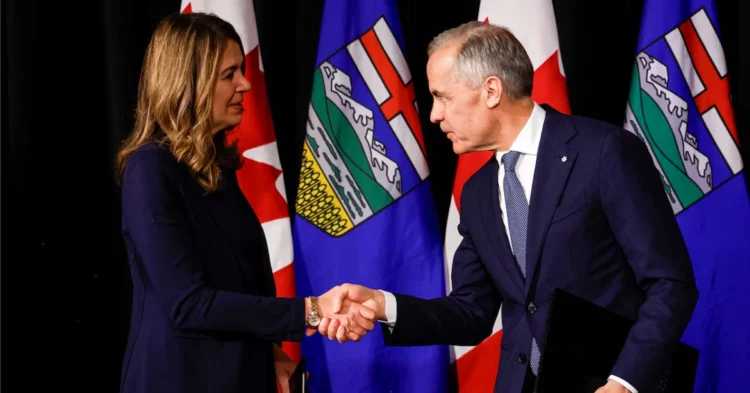
A major energy agreement between federal Prime Minister Mark Carney and Alberta Premier Danielle Smith has set the stage for one of the most consequential infrastructure and climate policy decisions in Canada in years. At the center of the deal is a potential new oil pipeline that could reshape the country’s energy exports, alongside a revised industrial carbon pricing framework that will gradually increase costs for emissions-intensive industries.
The agreement has triggered strong reactions across the political spectrum, from cautious optimism in parts of the energy industry to sharp criticism from environmental organizations and political leaders in British Columbia. It also raises unresolved questions about Indigenous consultation, provincial cooperation, private sector participation, and whether Canada’s climate commitments can remain intact while expanding fossil fuel infrastructure.
A new emissions pricing trajectory for Alberta
Under the agreement, Alberta will increase its effective industrial carbon emissions price to $130 per tonne by 2040, with a headline price reaching $140 per tonne in the same timeframe. This represents a significant rise from the current frozen rate of $95 per tonne.
The federal government had previously outlined a more aggressive national schedule reaching higher levels sooner, but this deal effectively reshapes the timeline while preserving an upward trajectory.
Supporters argue the revised structure provides long-term predictability for industry investment. Critics, however, warn it weakens near-term climate incentives at a moment when global emissions reduction efforts are accelerating.
Pipeline proposal tied to federal approval process
In exchange for the carbon pricing framework, Alberta has committed to submitting a proposal for a new oil pipeline to Canada Major Projects Office by July 1.
The federal government has stated it will “pursue” designation of the pipeline as a project of national interest by October 1, a classification that would streamline regulatory approvals and potentially accelerate construction timelines.
If everything proceeds as envisioned, Alberta has suggested that construction could begin as early as September 1, 2027.
However, that timeline remains highly conditional on regulatory approvals, private sector participation, Indigenous consultation outcomes, and political agreement from British Columbia.
The Political Architecture Behind the Deal
Federal framing: investment and climate compatibility
Prime Minister Mark Carney has defended the agreement as a form of climate-aligned economic development rather than a retreat from environmental policy. He has emphasized that both federal and provincial governments have committed in writing to achieving net-zero emissions by 2050.
According to Carney, the agreement balances industrial expansion with emissions management through carbon pricing and carbon capture investments. He has argued that the combined measures “more than compensate” for potential emissions increases associated with new infrastructure.
Alberta’s position: economic growth and regulatory certainty
Premier Danielle Smith and her government have framed the deal as a breakthrough that restores momentum to Alberta’s energy sector while maintaining a pathway for emissions management through technology.
Alberta officials argue that regulatory clarity is essential for unlocking large-scale private investment in pipelines and carbon capture infrastructure. They also maintain that Alberta’s oil and gas sector can remain globally competitive if Canada avoids overly restrictive policies that discourage development.
The Conditional Link: Pipeline and Carbon Capture Integration
Pathways carbon capture project as a prerequisite
A central condition of the agreement is the connection between pipeline development and a major carbon capture initiative known as the Pathways project. Federal officials have made clear that the pipeline is contingent on progress toward this carbon capture, utilization and storage system.
Intergovernmental Affairs Minister Dominic LeBlanc stated that the two projects are intended to move forward together if they proceed at all. He emphasized that federal approval of the pipeline would depend on whether the broader emissions reduction strategy remains credible and enforceable.
The Pathways project is designed to capture emissions from industrial oil production and store them underground, theoretically reducing the carbon intensity of exported oil.
Political disagreement over timing and sequencing
Alberta Social Services Minister Jason Nixon has suggested that the pipeline and carbon capture project do not necessarily need to advance in perfect synchronization. He has argued that industry stakeholders are confident in the feasibility of carbon capture technologies, though he acknowledges that implementation challenges remain significant.
This difference in interpretation highlights a broader tension: whether the pipeline is dependent on proven emissions reductions or whether it can proceed in parallel with developing climate technologies.
Industry Response: Optimism Mixed With Cost Concerns
Energy executives see opportunity and risk
Industry leaders have described the agreement as a combination of positive and negative signals. While the prospect of renewed pipeline development is welcomed, the increase in carbon pricing is viewed as a substantial new cost burden.
Adam Waterous of Strathcona Resources said the industry’s initial reaction reflects concern over higher carbon costs, which he described as difficult for producers to absorb in a globally competitive market.
At the same time, he acknowledged that the agreement provides more clarity than previous policy uncertainty, which has long been cited as a barrier to investment in Canadian energy infrastructure.
Oilsands producers seek clarity on competitiveness
The Oil Sands Alliance stated that while the agreement improves regulatory predictability, it also introduces higher operating costs that could reduce Canada’s competitiveness in global energy markets.
A key point of contention is whether global buyers are willing to pay a premium for what some policymakers call “decarbonized oil,” meaning oil produced with lower net emissions due to carbon capture and other mitigation technologies.
Industry leaders have expressed skepticism about that assumption, arguing that there is limited evidence of a consistent price premium for lower-carbon crude.
Environmental and Climate Policy Backlash
Concerns about Canada’s net-zero pathway
Environmental organizations have responded critically to the agreement, warning that it could undermine Canada’s long-term climate targets.
The Pembina Institute argued that the deal risks weakening clean energy investment and accelerating emissions growth. Similarly, the Canadian Climate Institute stated that the agreement could place Canada’s 2050 net-zero target further out of reach.
Their central concern is that any expansion of fossil fuel infrastructure locks in emissions for decades, even if carbon capture systems reduce a portion of output.
Political criticism from former federal leadership
Former environment minister Catherine McKenna publicly criticized the agreement, describing it as a setback for Canada’s climate strategy. She argued that accommodating industry demands risks weakening Canada’s competitiveness in the emerging global clean energy economy and shifting long-term costs onto future generations.
Her comments reflect a broader divide within Canadian climate policy circles over whether incremental emissions management is sufficient or whether more rapid fossil fuel phase-down is required.
British Columbia’s Opposition and Interprovincial Tensions
Premier David Eby rejects pipeline expansion
British Columbia Premier David Eby has strongly opposed the idea of a new pipeline to the Pacific coast. He has argued that the federal government is effectively rewarding political confrontation from Alberta by advancing pipeline discussions during a period of heightened interprovincial tension.
British Columbia’s position is critical because any pipeline to tidewater would likely require transit through the province and extensive consultation with coastal communities and First Nations.
Indigenous consultation remains unresolved
A major unresolved factor in the pipeline proposal is consultation with Indigenous rights holders. Federal officials have emphasized that Indigenous participation and consent will be a central criterion in any decision regarding national interest designation.
This introduces a complex legal and political process that could significantly delay or reshape the project, regardless of federal-provincial agreement.
Economic Feasibility and the Search for a Private Proponent
No confirmed private developer yet
One of the most significant unanswered questions is who will actually build the pipeline. At present, no private sector proponent has formally committed to the project.
The Alberta government has indicated it may act as an interim proponent in submitting the proposal, but officials acknowledge that long-term development will require private investment and industry participation.
Industry appetite depends on regulatory certainty
Alberta officials argue that improving regulatory conditions will eventually attract private developers. They believe that if carbon pricing and approval processes become predictable, major energy infrastructure firms will re-engage.
However, industry executives caution that uncertainty around timelines, political opposition, and carbon costs could still deter investment decisions even if regulatory frameworks improve.
Federal Messaging: Climate Policy Remains Intact
Government insists emissions targets are unchanged
Prime Minister Mark Carney has rejected claims that the agreement undermines Canada’s climate goals. He argues that the deal is consistent with net-zero commitments and reflects a broader strategy of balancing emissions reductions with economic development.
Intergovernmental Affairs Minister Dominic LeBlanc has similarly stated that Canadians should view the agreement as part of a broader suite of policies, including renewable energy expansion and electricity grid modernization.
Electricity grid expansion as parallel policy
Federal officials have pointed to ongoing efforts to double Canada’s electricity grid capacity by 2050 as evidence that the country is still pursuing a long-term clean energy transition. Natural gas is expected to play a transitional role in supporting grid stability during this expansion.
What Happens Next: Key Deadlines and Pressure Points
July and October decision milestones
The immediate next step is Alberta’s submission of a pipeline proposal to the federal Major Projects Office by July 1. Following that, the federal government will evaluate whether to designate the project as being in the national interest by October 1.
These decisions will determine whether the pipeline moves into accelerated regulatory pathways or remains stalled in political and legal uncertainty.
2027 potential construction timeline remains uncertain
Although Alberta has floated a potential construction start date in 2027, that timeline depends on several unresolved variables, including:
Federal approval under national interest designation
Agreement from British Columbia
Indigenous consultation outcomes
Private sector financing and participation
Final carbon capture implementation plans
Any delay in these areas could push timelines significantly further into the future.
Conclusion: A High-Risk, High-Reward Energy Gamble
The agreement between Mark Carney and Danielle Smith represents an attempt to reconcile two competing priorities: expanding Canada’s fossil fuel export capacity while maintaining a credible pathway to net-zero emissions by 2050.
Supporters see it as a pragmatic compromise that brings long-sought clarity to the energy sector and could unlock major infrastructure investment. Critics view it as a risky concession that may lock in long-term emissions and weaken Canada’s climate leadership.