
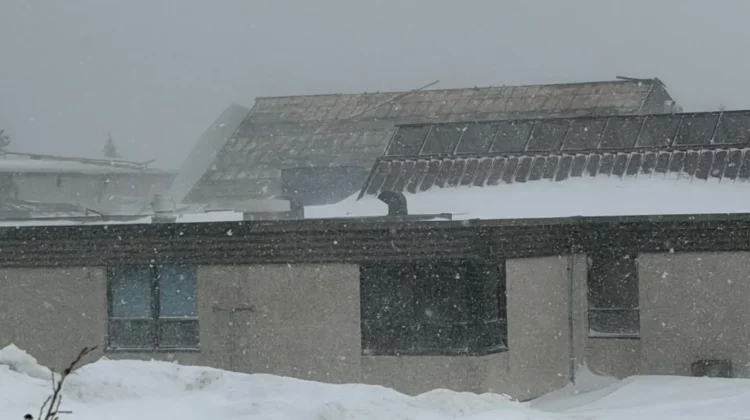
A powerful windstorm that swept through northern Alberta on March 8 brought sudden disruption to the small town of Swan Hills, forcing students out of their classrooms and into temporary learning spaces. What began as a severe weather event quickly turned into a test of resilience, coordination, and community spirit.
Swan Hills, located about 225 kilometres northwest of Edmonton, is a close-knit community where people are used to supporting one another through harsh winters and remote living conditions. However, the intensity of this storm was unlike anything many residents could recall in recent years.
With wind gusts exceeding 120 kilometres an hour, the storm moved through the region with force, leaving visible damage across town infrastructure and, most significantly, the local school complex.
Wind Gusts Exceed 120 Kilometres an Hour and Cause Structural Damage
Extreme Weather Hits the School Infrastructure
The storm’s most disruptive impact came when powerful winds tore through the school area and adjoining structures. The roof of a nearby pool building was ripped off entirely, sending debris into surrounding areas. That debris, combined with sustained wind pressure, also caused damage to the roof of the school building itself.
The damage was severe enough that school officials immediately determined the building was unsafe for students and staff. Safety inspections confirmed that classrooms could not be used until repairs were completed, forcing an immediate shutdown of in-person learning at the school.
For a rural community where the school is not only an educational institution but also a central gathering place, the closure created an immediate logistical and emotional challenge.
A Sudden Disruption to Daily Learning
Students and teachers were suddenly left without their regular learning environment. There was no time for gradual transition or long-term planning. Within hours of the storm, school operations had to be suspended, and alternative arrangements became a priority.
The situation required rapid coordination between school leadership, municipal services, local organizations, and families to ensure that education could continue in some form while repairs were carried out.
Immediate Aftermath and Community Response
School Leadership Responds Quickly to an Unexpected Crisis
Sherry Fan Miller, the principal of Swan Hills School, described how quickly the situation escalated and how the community responded almost immediately after the storm passed.
Within a day or two, she began receiving calls and messages from various organizations across town offering assistance.
According to Miller, the response was both fast and unified. Local agencies, community groups, and residents began asking what they could do to support students and staff during the disruption. This immediate willingness to help played a crucial role in minimizing the impact on students’ education.
Coordination Becomes the First Priority
Once the extent of the damage was understood, the focus shifted to finding usable spaces where learning could continue. The school needed a safe environment, furniture, learning materials, and logistical support to operate outside its building.
Rather than attempting a fragmented solution, community leaders and school staff worked together to identify central locations that could temporarily host classes. This is where two major community spaces became essential: the Swan Hills Curling Club and the local community centre.
Community Spaces Transformed Into Temporary Classrooms
Curling Club Becomes a School Almost Overnight
One of the most significant examples of community involvement came from the Swan Hills Curling Club. Jennifer Stenberg, an executive member of the club, described how quickly the transformation took place once the decision was made to use the facility as a temporary school site.
Teachers, school support staff, and community volunteers came together to move essential classroom materials out of the damaged school building. Desks, chairs, books, and teaching resources were carefully packed and transported to the curling club and the community centre.
Within a matter of hours, both spaces were reorganized to function as learning environments. Classrooms were recreated in non-traditional settings, with whiteboards set up, seating arranged, and schedules adjusted to ensure continuity in education.
Community Effort Defines the Transition
The speed and coordination of the relocation highlighted the strength of Swan Hills as a small community. Residents who were not directly connected to the school also volunteered their time and resources. Some helped with transportation, others assisted in setting up classroom spaces, and many simply offered support wherever it was needed.
This collective effort allowed students to resume their learning quickly, even though their school building remained unusable.
Learning Continues in Temporary Environments
Adapting to a New Way of Schooling
While the curling club and community centre provided safe and functional spaces, the transition was not without challenges. Teachers had to adjust lesson plans to fit unconventional classroom layouts. Students had to adapt to learning in shared or modified environments that were very different from traditional classrooms.
Despite these challenges, the focus remained on maintaining a sense of normalcy. Teachers worked to ensure that academic progress continued, even if the environment was temporary and unconventional.
The experience also introduced students to a different kind of learning environment, one shaped by adaptability and cooperation rather than routine structure.
Maintaining Stability for Students
For school staff, one of the main priorities was ensuring emotional stability for students. Sudden displacement from a familiar environment can be disruptive, particularly for younger learners. Teachers and support staff placed emphasis not just on academics, but also on reassurance and routine.
Keeping schedules consistent, maintaining familiar teaching practices, and creating a welcoming atmosphere in the temporary locations all helped reduce the stress of the transition.
Repair Work and Restoration of the School Building
Assessing and Repairing Storm Damage
While classes continued in temporary spaces, repair crews began working on the damaged school building. The process involved assessing structural damage to both the roof and affected interior areas. The removal of debris and stabilization of the building were immediate priorities before reconstruction could begin.
The damage caused by the storm required careful repair work, particularly given the safety requirements for reopening a school building. Roofing repairs and structural reinforcement were key components of the restoration effort.
Two Weeks of Intensive Recovery Work
Over the course of approximately two weeks, repair teams worked to restore the building to a safe and functional condition. The relatively short timeframe was made possible by coordinated efforts between local authorities, contractors, and the school administration.
During this period, communication between all parties remained essential. Updates were regularly shared with families, ensuring that parents were aware of progress and expected timelines for reopening.
Return to the School Building
Students Reunite With Their Classrooms
Once repairs were completed and safety inspections confirmed the building was ready for use, students were able to return to their original school environment. The return marked the end of a brief but intense period of disruption for the community.
For many students, walking back into the building carried a sense of relief and familiarity after two weeks of adjustment in temporary settings.
Emotional Impact of Returning
The return to the school building was more than just a logistical transition. It represented a return to normal routines and a reaffirmation of stability after an unexpected crisis. Students and staff alike expressed appreciation for the quick recovery and the support that made it possible.
Grade 12 student Riki Rolof reflected on the experience, emphasizing the importance of having a strong support system. For her, the situation highlighted the value of living in a small community where people are willing to come together during difficult times.
She described Swan Hills as a tight-knit community where support is always present when it is needed most.
Lessons in Community Strength and Resilience
A Small Town Response to a Major Disruption
The storm that affected Swan Hills demonstrated how quickly a small town can mobilize in response to an emergency. While the physical damage required technical repair work, the emotional and logistical challenges were met through community cooperation.
Schools are often central to rural communities, and their disruption affects more than just students. In this case, the entire town played a role in ensuring that education continued without long-term interruption.
The Role of Collective Action
From school administrators to curling club members, from teachers to volunteers, the response was unified and practical. Each group contributed in a different way, but all shared the same goal of supporting students.
This collective action ensured that what could have been a prolonged disruption was reduced to a brief transition period.
Enduring Impact on Students and Community
For students, the experience became an unexpected lesson in adaptability and resilience. For the broader community, it reinforced the importance of preparedness and cooperation in the face of natural events.
The story of Swan Hills during this windstorm is not only about damage and repair but also about how quickly a community can come together to restore normal life.
Conclusion: A Community That Restored More Than Just a Building
The windstorm that struck Swan Hills in March caused significant disruption, damaging school infrastructure and forcing students out of their classrooms. Yet the response that followed turned a difficult situation into a powerful example of community strength.