
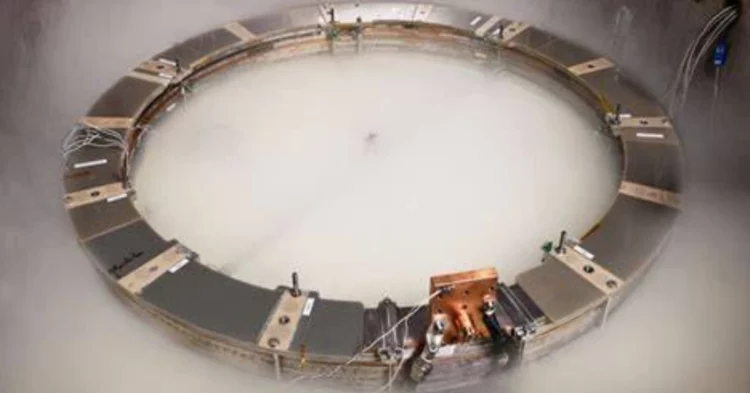
In a landmark scientific achievement, China has introduced the HH70, the world’s first tokamak fusion reactor powered by high-temperature superconductors (HTS). Developed in eastern Shanghai, this breakthrough positions China as a leader in the global race to commercialize clean, limitless fusion energy. More than just a technical milestone, the HH70 could usher in a new era of sustainable power with profound environmental and economic implications.
Table of Contents
How Fusion Energy Works: Powering Earth Like the Sun
Fusion vs. Fission: The Safer, Cleaner Alternative
Unlike nuclear fission—which splits heavy atoms like uranium to release energy—fusion combines light atomic nuclei, typically isotopes of hydrogen, to form helium, releasing enormous energy in the process. This is the same principle that powers the sun.
According to the International Atomic Energy Agency (IAEA), fusion offers up to four times the energy output of fission with significantly less radioactive waste, no long-lived radioactive byproducts, and zero greenhouse gas emissions.
Why Fusion Energy Is the Holy Grail of Clean Power
Key Benefits of Fusion Over Traditional Energy Sources
- Abundant fuel supply: Derived from hydrogen isotopes found in water and lithium
- No carbon emissions: Clean during operation
- Inherent safety: No risk of meltdown
- Minimal waste: Short half-lives, easier to manage
- Massive energy yield: High energy density makes it vastly more efficient
The tokamak—a doughnut-shaped magnetic containment device—is the leading design in the pursuit of sustainable fusion energy. It uses powerful magnetic fields to confine and control plasma at temperatures exceeding millions of degrees Celsius, enabling fusion reactions to occur.
HH70: The World’s First Tokamak with High-Temperature Superconductors
Engineering Innovation Using REBCO Materials
What sets the HH70 apart is its use of Rare Earth Barium Copper Oxide (REBCO) high-temperature superconductors—materials that dramatically improve magnetic field efficiency, allowing for smaller, cheaper, and more powerful reactors.
According to Dr. Li Wei, a lead researcher at the Shanghai Institute of Plasma Physics, “The implementation of HTS technology in the HH70 makes fusion reactors more economically viable while accelerating their development toward commercial applications.”
This breakthrough could radically shorten the path to energy-positive fusion power.
The Race to Achieve Q=10: Energy Singularity’s Bold Roadmap
Understanding the Q Value in Fusion
The Q value represents how much energy a reactor produces compared to how much it consumes. Most experimental reactors today remain below breakeven, with the current record at Q = 1.53. Energy Singularity, the firm behind the HH70, aims to achieve Q = 10 by 2030—a landmark threshold where a reactor produces 10 times the energy it consumes.
Project Milestones
| Milestone | Target Year | Expected Outcome |
|---|---|---|
| Next-generation tokamak | 2027 | Improved plasma control and efficiency |
| Technology demonstrator | 2030 | Achieve Q = 10 (energy-positive fusion) |
| Commercial reactor launch | Post-2030 | Grid-integrated fusion power |
A Global Turning Point for Clean Energy and Climate Solutions
Fusion’s Potential Impact on the Global Energy Mix
The significance of the HH70 extends far beyond China’s borders. According to the World Energy Council, a successful fusion rollout could fundamentally reshape the world’s energy mix, sharply decreasing global reliance on fossil fuels and mitigating climate change.
Energy Singularity’s vision includes:
- Continuous testing and optimization of HH70
- Scaling up fusion output for national grids
- Achieving commercial fusion power in the early 2030s
- Contributing to a global shift toward carbon-free energy infrastructure
Conclusion: A Star on Earth, A Future Within Reach
The unveiling of the HH70 high-temperature superconductor tokamak is more than a scientific first—it’s a bold step toward a sustainable, secure, and virtually limitless energy future. By replicating the process that powers the stars, China is demonstrating how cutting-edge innovation can confront some of humanity’s most urgent challenges: climate change, energy scarcity, and environmental degradation.