
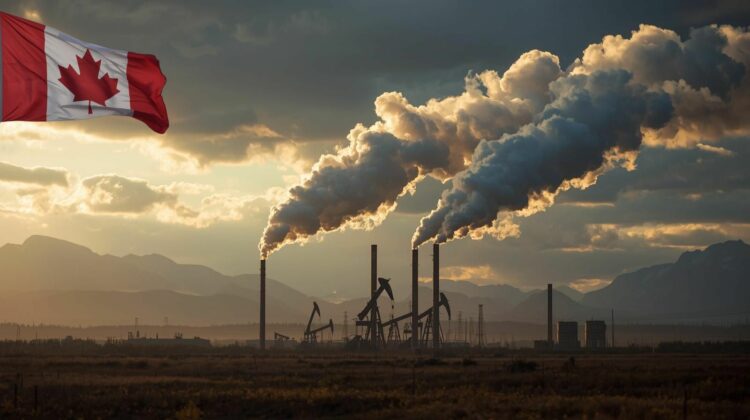
Canada’s emissions reductions slowed to almost zero in 2024, raising serious concerns about whether the country can meet its climate targets. New federal data shows that progress on Canada’s emissions reductions has nearly stalled, even as long-term goals remain ambitious.
The latest update on Canada’s emissions reductions highlights a growing gap between policy commitments and real-world results.
Canada’s Emissions Reductions Slowed to Almost Zero in 2024
According to recent federal reporting, Canada’s emissions reductions slowed to almost zero in 2024, marking one of the weakest years for progress in recent times.
Early estimates show emissions dropped by only about 0.3% compared with 2023, meaning Canada’s emissions reductions barely moved forward.
This slowdown in Canada’s emissions reductions comes after years of gradual decline, suggesting that existing policies may not be enough to maintain momentum.
Canada’s Emissions Reductions vs Long-Term Climate Targets
Despite the slowdown, Canada still maintains aggressive climate goals. The federal government has committed to reducing greenhouse gas emissions by 40% to 45% below 2005 levels by 2030.
Canada has also set a longer-term pathway toward net-zero emissions by 2050 under national climate legislation.
However, the fact that Canada’s emissions reductions slowed to almost zero in 2024 raises concerns about whether these targets remain achievable without stronger action.
Why Canada’s Emissions Reductions Slowed in 2024
Federal data and reports suggest that mixed performance across sectors played a major role in why Canada’s emissions reductions slowed.
Some sectors continued to reduce emissions, including:
- Electricity generation
- Buildings and energy efficiency
But these gains were offset by increases in other areas, particularly:
- Oil and gas production
- Agriculture
In fact, the oil and gas sector remains the largest contributor to emissions, accounting for about 31% of Canada’s total greenhouse gas output.
This imbalance is a key reason why Canada’s emissions reductions slowed to almost zero in 2024.
Historical Progress in Canada’s Emissions Reductions
Over the longer term, Canada has made some progress. Emissions have declined from 761 megatonnes in 2005 to around 708 megatonnes in recent years.
This shows that Canada’s emissions reductions are real, but the pace has been uneven and inconsistent.
The latest data reinforces that Canada’s emissions reductions are not happening fast enough to meet upcoming deadlines.
Role of Carbon Pricing in Canada’s Emissions Reductions
One of the central tools in Canada’s climate strategy is carbon pricing.
Federal data shows that carbon pricing could contribute up to one-third of Canada’s emissions reductions by 2030.
The system is designed to encourage businesses and households to reduce emissions by making pollution more costly.
However, the fact that Canada’s emissions reductions slowed to almost zero in 2024 suggests that carbon pricing alone may not be sufficient.
Canada’s Emissions Reductions and the 2030 Plan
The federal government’s 2030 Emissions Reduction Plan outlines a detailed roadmap to cut emissions across all major sectors.
This includes:
- Clean electricity regulations
- Transportation reforms
- Industrial emission limits
- Investments in green technology
The plan aims to ensure Canada’s emissions reductions accelerate significantly before 2030.
But the 2024 slowdown indicates that implementation challenges remain.
Key Challenge: Rising Emissions in Major Sectors
A major issue behind the slowdown is that some of Canada’s largest industries are still expanding.
For example:
- Oil sands production continues to grow
- Transportation demand remains high
- Agricultural emissions are difficult to reduce
These factors are offsetting progress in cleaner sectors, making it harder for overall Canada’s emissions reductions to move forward.
What the 2024 Data Means for Canada’s Climate Future
The fact that Canada’s emissions reductions slowed to almost zero in 2024 is a critical warning.
It suggests that:
- Current policies are not delivering consistent results
- Stronger regulations may be needed
- Sector-specific actions must be accelerated
Without significant changes, Canada risks falling behind its 2030 emissions reduction target.
Can Canada Get Back on Track?
Despite the slowdown, federal projections still suggest Canada can meet its targets if additional measures are fully implemented.
These include:
- Stricter methane regulations
- Caps on oil and gas emissions
- Expansion of clean electricity
- Increased adoption of electric vehicles
If these measures are executed effectively, Canada’s emissions reductions could accelerate again in the coming years.
Canada’s emissions reductions slowed to almost zero in 2024, marking a pivotal moment in the country’s climate journey.
While long-term goals remain in place, the latest data shows that progress is fragile and uneven. The coming years will be crucial in determining whether Canada can turn this slowdown into a renewed push toward meaningful emissions reductions.
The challenge is no longer about setting targets. It is about delivering real, measurable results at a much faster pace.