
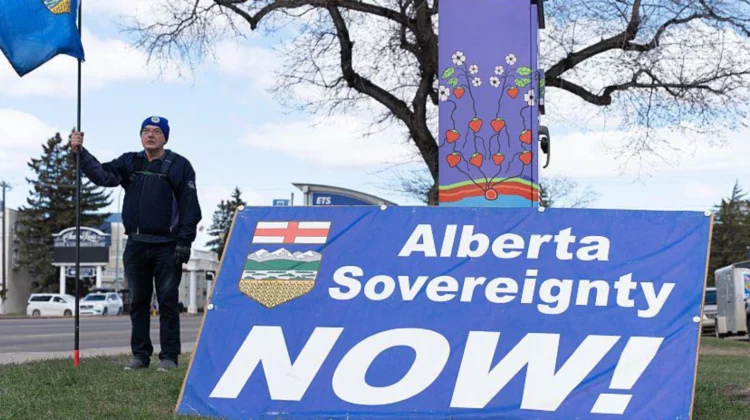
A dramatic political and legal battle in Canada has intensified after an Alberta judge struck down a petition aimed at launching a referendum on the province’s separation from Canada. The ruling has placed Indigenous treaty rights at the center of one of the country’s most divisive constitutional debates and raised serious questions about Alberta’s growing separatist movement.
Justice Shaina Leonard delivered a detailed 37-page decision in an Edmonton courtroom on Wednesday, concluding that Alberta failed in its legal duty to consult several First Nations communities before allowing a citizen-led petition for independence to proceed.
The decision immediately halted the verification of more than 300,000 signatures gathered by the pro-independence organization Stay Free Alberta. Those signatures had reportedly surpassed the threshold needed to trigger a province-wide referendum on Alberta’s future within Canada.
The ruling now leaves the fate of the proposed referendum uncertain while also highlighting the powerful constitutional protections Indigenous communities possess under Canadian law.
Why the Alberta Independence Movement Has Gained Momentum
The Alberta separatist movement has existed for decades, but it has recently gained renewed energy due to mounting political frustration within the western province.
Many Albertans believe the federal government in Ottawa has consistently ignored the province’s economic interests, particularly regarding the oil and gas sector. Alberta’s economy heavily depends on natural resources, and critics of federal policies argue that environmental regulations and climate-focused legislation have damaged the province’s prosperity.
Supporters of separation often claim Alberta contributes more wealth to Canada than it receives in return. They argue that federal decisions are frequently shaped by political priorities in eastern Canada while western provinces are sidelined.
Cultural and political differences have also deepened tensions. Alberta generally leans more conservative than much of the country, creating friction with Liberal governments in Ottawa.
Although not all separatists advocate complete independence, many support increased provincial autonomy, stronger control over natural resources, and reduced federal influence over Alberta’s economy.
The Court Decision That Changed Everything
Justice Leonard’s ruling centered on a key constitutional issue: the rights of Indigenous First Nations communities whose treaties predate the creation of modern Alberta.
The legal challenge was brought forward by four First Nations groups:
Athabasca Chipewyan First Nation
Blood Tribe
Piikani Nation
Siksika Nation
These nations argued that Alberta’s attempt to pursue a referendum on separation directly affected treaty agreements signed with the Crown in the nineteenth century.
According to the court, Alberta could not move toward a referendum without first meaningfully consulting Indigenous communities whose treaty rights might be impacted.
Justice Leonard wrote that Alberta’s separation from Canada would unquestionably affect the treaties and constitutional relationships between First Nations peoples and the Crown.
She stated that “as a matter of logic and common sense,” there could be no doubt that secession would impact treaty rights.
The judge further concluded that no meaningful consultation took place before the petition process advanced.
Understanding Canada’s Duty to Consult Indigenous Peoples
The ruling is rooted in a major principle of Canadian constitutional law known as the “duty to consult.”
Under Canadian law, governments must consult Indigenous communities whenever proposed actions could potentially infringe upon Aboriginal or treaty rights.
This duty is not symbolic. Courts have repeatedly ruled that consultations must be meaningful, conducted in good faith, and involve genuine engagement with affected Indigenous groups.
The consultation requirement exists because treaties between Indigenous nations and the Crown are constitutionally protected under Section 35 of Canada’s Constitution Act, 1982.
In practical terms, this means governments cannot simply ignore Indigenous interests when making major political or economic decisions that could alter treaty relationships.
Justice Leonard’s ruling suggests that Alberta’s proposed independence referendum represented one of the most significant constitutional changes imaginable and therefore required extensive consultation.
Why First Nations Opposed Alberta Separation
For many Indigenous leaders, Alberta independence raises serious concerns about sovereignty, treaty obligations, and territorial rights.
Lawyers representing the First Nations argued that separation from Canada could fundamentally alter the legal framework protecting Indigenous communities.
Kevin Hille, legal counsel for Athabasca Chipewyan First Nation, called the ruling a major victory for constitutional rights and the rule of law.
He emphasized that an international border separating Alberta from Canada could severely disrupt traditional Indigenous ways of life.
Many First Nations communities maintain cultural, familial, and territorial connections that extend beyond provincial boundaries. Hunting grounds, ceremonial sites, trade routes, and migration patterns have existed for thousands of years across regions that today form parts of several Canadian provinces.
Indigenous leaders fear that Alberta independence could interfere with mobility rights, treaty enforcement, resource access, and governance relationships with the federal Crown.
Hille argued that such a dramatic constitutional transformation could not legally proceed without serious dialogue and consultation.
Stay Free Alberta Pushes Back Against the Ruling
The separatist organization Stay Free Alberta strongly criticized the court’s decision and vowed to continue fighting for a referendum.
Jeff Rath, the lawyer representing the movement, accused the ruling of containing significant legal errors and violating principles of natural justice.
Rath confirmed the group intends to appeal the decision and may seek a court order to temporarily suspend Justice Leonard’s ruling while the appeal process unfolds.
He also warned that Alberta Premier Danielle Smith could face growing political pressure from supporters of independence who expect the referendum question to appear on the ballot.
According to Rath, many Albertans who signed the petition will demand that the provincial government continue moving forward despite the legal setback.
The organization argues that citizens should have the democratic right to vote on Alberta’s constitutional future.
Premier Danielle Smith Signals Possible Appeal
Alberta Premier Danielle Smith responded cautiously but indicated her government believes the ruling may contain legal errors.
Speaking to reporters, Smith said Alberta was reviewing the judgment and considering an appeal.
She stressed that citizen-led referendums should allow voters to express opinions on any issue, even highly controversial constitutional matters.
Her government recently amended provincial legislation to remove a previous requirement that citizen-initiated referendum questions must first be deemed constitutional.
Critics argued that the change opened the door to legally questionable referendum campaigns, including efforts promoting Alberta separation.
Supporters, however, viewed the amendment as a necessary expansion of democratic participation.
Smith now faces a difficult political balancing act. While full separation remains controversial, separatist sentiment has become increasingly influential within parts of Alberta’s conservative base.
The October Referendum Questions Could Become Explosive
Before the court ruling, Alberta was already preparing for a province-wide vote in October focused on immigration issues and provincial powers.
Separatist activists hoped an Alberta independence question would be added to that ballot.
Now, the legal uncertainty surrounding the petition has thrown those plans into chaos.
If appeals move quickly, the referendum issue could still return before October. However, prolonged court battles could delay any future vote indefinitely.
The outcome could also shape Premier Smith’s political future.
Separatist supporters are pressuring her government to defend the referendum effort aggressively, while opponents warn that pushing constitutional conflict could deepen divisions within Alberta and across Canada.
Alberta’s Frustration With Ottawa Runs Deep
The roots of Alberta separatism are tied to decades of political resentment toward the federal government.
Many Albertans believe Ottawa has unfairly restricted the province’s energy sector through environmental legislation, pipeline regulations, and emissions policies.
Oil and gas remain central to Alberta’s economy, and federal climate policies are often viewed locally as direct threats to jobs and economic growth.
This frustration intensified during Liberal governments led by Prime Minister Justin Trudeau, whose climate agenda became a lightning rod for western discontent.
Some Albertans argue the province’s resource wealth disproportionately benefits the rest of Canada while Alberta receives insufficient political influence in return.
Others feel culturally disconnected from eastern Canada and believe western concerns are regularly ignored in national political debates.
These grievances have fueled increasing support for provincial autonomy movements and separatist organizations.
Could Alberta Really Separate From Canada?
Despite growing separatist rhetoric, actual separation would face enormous legal and constitutional barriers.
Canada’s Supreme Court addressed similar questions during debates over Quebec independence in the late 1990s.
The court ruled that no province can unilaterally separate from Canada under either Canadian or international law. Instead, any successful attempt at secession would require negotiations involving the federal government, provinces, and Indigenous groups.
An Alberta separation process would likely trigger years of constitutional negotiations involving issues such as:
Indigenous treaty rights
Federal assets and debt
Currency and banking systems
International borders
Trade agreements
Citizenship rights
Military and security arrangements
Energy exports and pipelines
The presence of constitutionally protected Indigenous treaties would make negotiations even more complex.
Many legal experts believe Indigenous nations themselves could assert independent rights or reject inclusion in a separate Alberta altogether.
Indigenous Rights Could Shape Canada’s Constitutional Future
Justice Leonard’s ruling may have implications extending far beyond Alberta.
The decision reinforces the growing legal and political power Indigenous communities hold in major constitutional matters across Canada.
Courts have increasingly recognized that Indigenous rights cannot be treated as secondary concerns during national political disputes.
The ruling also demonstrates how treaty obligations remain deeply embedded within Canada’s constitutional framework.
For Indigenous leaders, the decision represents recognition that treaty relationships are foundational agreements that cannot simply be bypassed during political movements for provincial independence.
For separatists, however, the ruling may become a rallying point against what they see as legal obstacles preventing democratic expression.
What Happens Next in Alberta’s Independence Fight
The future of Alberta’s independence movement now depends on several major developments.
Stay Free Alberta is expected to pursue an appeal, potentially leading to higher court rulings that could reshape how consultation requirements apply to referendum campaigns.
Premier Danielle Smith must decide how aggressively her government wants to defend the referendum process while balancing broader public opinion.
Meanwhile, First Nations groups are likely to continue asserting that any constitutional changes affecting treaty relationships require full consultation and participation.
The political tension surrounding Alberta’s place within Canada appears far from over.
Even if the current referendum effort fails, the underlying frustrations driving separatist sentiment remain powerful forces within Alberta politics.