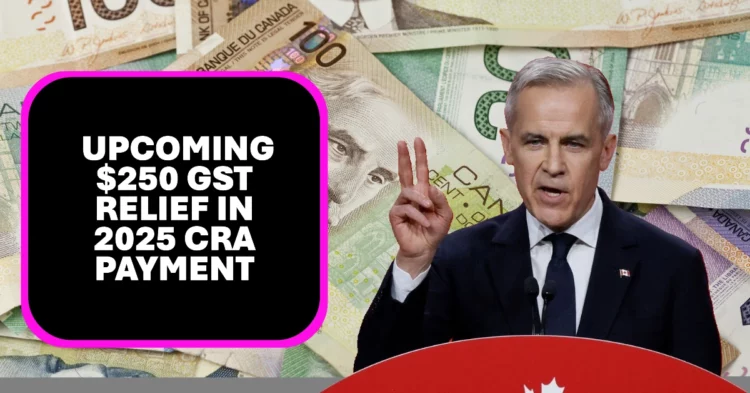
With rising costs across the board, many Canadians, especially those working hard to make ends meet, are looking for any relief they can get. The Canada $250 GST Relief Payment is set to offer a financial break for those feeling the squeeze in 2025. If you’re like many of us—working in a regular job and trying to stretch every paycheck to cover bills—this one-time payment might be just the relief you’ve been waiting for. Here’s everything you need to know about how to qualify, when to expect your payment, and why it’s an important lifeline for many Canadians.
Table of Contents
What Is the Canada $250 GST Relief Payment in 2025?
The Canada $250 GST Relief Payment, also known as the Working Canadians Rebate, is a one-time, tax-free financial relief offered by the Canadian government to help combat the ongoing effects of inflation. Targeted primarily at those who have worked in 2023, the rebate aims to support the everyday Canadian worker. This payment is designed to ease some of the financial burden, particularly during these times of price hikes that have affected groceries, utilities, and more.
Why Is This Payment Important?
Amid high inflation rates, many middle-class families and individuals have struggled to manage their finances. As prices rise, the cost of living has become increasingly difficult to handle. This rebate provides a much-needed boost, particularly for those balancing work and family responsibilities. The payment amount is fixed at $250 per eligible adult, which might not sound like much, but for many, it can cover basic necessities like groceries or utilities.
Along with this rebate, Canada is also offering a Winter GST Holiday (from December 14, 2024, to February 15, 2025), which will waive the GST/HST on essential items like groceries, kids’ clothes, books, and toys, adding additional savings of between $100 to $260 for some households.
Who Is Eligible for the Canada $250 GST Relief Payment?
Basic Eligibility Criteria
To qualify for this rebate, you must meet the following conditions:
- Income Requirement: You need to have worked in 2023, and your net income must be under $150,000.
- Tax Filing: You must have filed your 2023 tax return by December 31, 2024.
- Canadian Residency: You must be a Canadian resident as of March 31, 2025.
- Criminal Record: You cannot have been incarcerated for 90 days or more prior to April 1, 2025.
Special Considerations for Certain Groups
- Seniors and Immigrants: The rebate is available to seniors and immigrants, provided they meet the income cap and residency requirement.
- No Kids Required: Unlike some other programs, you do not need children to qualify. A single adult with a net income under $150,000 can still receive the full $250.
- Previous GST/HST Credit Recipients: If you’ve received GST/HST credits in the past, chances are you’re already eligible for this rebate.
If you’re unsure about whether you qualify, you can easily check your status through your CRA My Account or by contacting the Canada Revenue Agency (CRA) at 1-800-959-8281.
When Will You Receive the Canada $250 GST Relief Payment?
The payments will be distributed in early spring 2025, with most Canadians expecting to see their funds by March or April 2025. Some may receive direct deposits even earlier in February 2025, depending on their tax filing and direct deposit information.
Key Dates to Remember:
- Tax Filing Deadline: Make sure your 2023 tax return is filed by December 31, 2024, to qualify.
- Payment Window: Expect the payment to hit your bank account or mailbox sometime in March-April 2025.
Note that the CRA will handle this payment automatically for most eligible individuals, so you won’t need to apply. Just ensure your tax info is up to date!
Canada’s $628 Grocery Rebate Payment for August 2025 Eligibility Key Dates and How to Claim It
Canada’s Retirement Age and Pension Rules Face Review in 2025
CRA’s $628 Grocery Rebate Arrives August 19 See If You Qualify for the Payment
Canada’s $628 Rebate Coming August 2025 CRA Eligibility & Payment Details
How to Apply for the Canada $250 GST Relief Payment
The best part about this rebate is that you don’t need to apply separately. The payment is based on the information from your 2023 tax return.
Step-by-Step Process:
- File Your 2023 Tax Return: Even if you don’t owe taxes, file your return by December 31, 2024.
- Update CRA My Account: Ensure your direct deposit information is up to date in your CRA My Account. This will allow for a quicker payment.
- Wait for Payment: The CRA will send out notices in early 2025 confirming your eligibility. If you’re eligible, expect the $250 to be deposited automatically or sent as a cheque.
- Check Your Status: If you’re unsure of your status, you can log in to your CRA My Account or contact CRA for clarification.
Pros and Cons of the Canada $250 GST Relief Program
Advantages of the $250 GST Relief Payment
- Tax-Free Cash: This payment is completely tax-free, meaning the $250 you receive is yours to use as needed.
- No Application Required: For most, this is an automatic payment—no need for paperwork or additional hoops to jump through.
- Helpful for Working Canadians: It provides targeted relief to workers under the $150,000 income threshold, offering support to middle-class individuals and families.
- Stackable with Other Benefits: If you’re eligible for other credits, like the GST/HST Credit, you can still benefit from this rebate.
Disadvantages of the $250 GST Relief Payment
- One-Time Payment: Unlike quarterly rebates or ongoing support, this is a one-off payment.
- Excludes Higher Earners: Canadians with incomes above $150,000 are excluded from this program, limiting its impact for higher-income individuals.
- No Family Additions: This rebate is set at a flat rate of $250 per person, so it doesn’t scale with family size like some other programs.
Canada $250 GST Rebate vs. Other Benefits
Comparing the GST Relief with the GST/HST Credit and Carbon Rebate
- GST/HST Credit: This ongoing benefit can provide up to $496 per year for singles, paid quarterly. The $250 GST Relief is a one-time payment, but it’s still worth taking advantage of alongside other credits.
- Carbon Rebate: The Canada Carbon Rebate can provide up to $1,000 per family and phases out in 2025. It’s a larger benefit than the $250 rebate, but it has different eligibility criteria and is more focused on environmental initiatives.
If you’re eligible for multiple programs, you can stack the benefits to increase your total relief!