
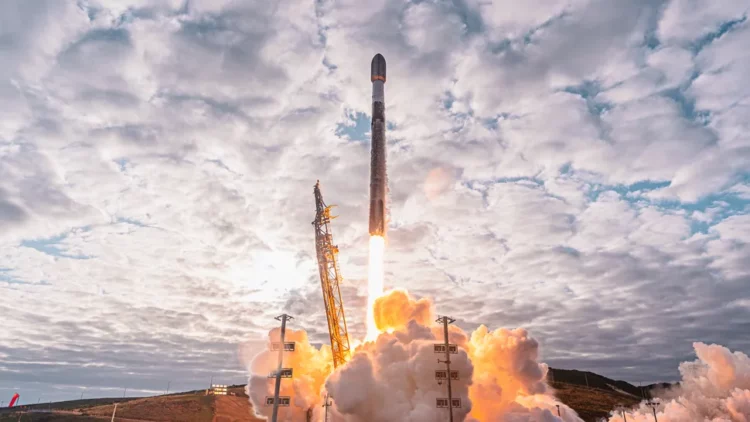
South Korea’s advanced Earth observation satellite, long delayed by global geopolitics, is finally heading to orbit aboard a SpaceX Falcon 9 rocket. This SpaceX rocket launch marks a major milestone for Korea’s push toward independent space capabilities and industry-led satellite development.
Cha Middle 2 (CAS500-2): A Powerful New Asset for Earth Observation
The Next-Generation Medium Satellite 2, often called Cha Middle 2 or CAS500-2, is set for launch from Vandenberg Space Force Base in California. According to the Korea AeroSpace Administration, liftoff is targeted for approximately 3:59 p.m. local time (or early May 3 windows around 12 a.m. PT / 3 a.m. ET) on a SpaceX Falcon 9.
About 60 minutes after launch, the satellite will separate from the rocket. Roughly 15 minutes later, it is expected to make first contact with the Norwegian Svalbard Ground Station. This SpaceX launch today is a rideshare mission carrying the primary Korean satellite plus around 44 additional payloads.
Key specifications of Cha Middle 2:
- Weight: 534 kg
- Resolution: 0.5 meters in black-and-white, 2 meters in color
- Planned orbit: Approximately 498 km altitude
- Commissioning period: Four months of initial operations before full mission in the second half of 2026
Once operational, it will deliver high-precision imagery supporting national land resource management, disaster response, agricultural monitoring, and spatial information services.
From Government Tech to Private Sector Triumph: The Project’s History
The Next-Generation Medium Satellite project kicked off in 2015 with a bold goal — develop a standardized 500 kg-class satellite platform and shift South Korea’s space industry from purely government-led to industry-driven.
Korea Aerospace Industries (KAI) collaborated with the Korea Aerospace Research Institute on the first satellite (Cha Middle 1), gaining critical expertise. Cha Middle 2 represents the first fully independent development by KAI following technology transfer from the government. This launch serves as a landmark “test case” for private sector involvement in actual orbital missions.
Why the Long Delay? Geopolitics and Launch Market Shifts
Originally planned for launch in the second half of 2022 on a Russian rocket, the mission faced nearly four years of setbacks due to the Russia-Ukraine war, which disrupted the contract.
KAI then pivoted to SpaceX, initially targeting a paired launch with Cha Middle 4 in 2025. Further schedule adjustments by SpaceX pushed the timeline, resulting in Cha Middle 2 launching after CAS500-3 (deployed via South Korea’s Nuri rocket in late 2025).
This SpaceX rocket launch highlights the resilience of international space partnerships and the growing reliability of commercial providers like SpaceX for critical national payloads.
Strategic Importance for South Korea
Cha Middle 2 strengthens South Korea’s sovereign Earth observation capabilities. High-resolution imaging will aid in:
- Monitoring land use and urban development
- Rapid disaster assessment (floods, wildfires, earthquakes)
- Supporting agriculture and environmental management
- Enhancing national security through detailed spatial intelligence
By reducing reliance on foreign launch providers and building domestic expertise, Korea advances its ambitions in the global space economy.
The Broader SpaceX Launch Ecosystem
This mission fits into SpaceX’s busy cadence of Falcon 9 flights, known for reusable technology that drives down costs and increases launch frequency. The booster on this flight (reportedly on its 33rd mission in some updates) underscores the maturity of SpaceX’s fleet.
Rideshare passengers on this SpaceX launch include additional imaging satellites and other payloads, making it an efficient multi-mission flight to low Earth orbit, specifically sun-synchronous orbit ideal for Earth observation.
What’s Next After Launch?
Following successful deployment and checkout, Cha Middle 2 will begin its primary operations later in 2026. Its data will feed directly into South Korean government and industry applications, potentially expanding to international partnerships.
This event not only celebrates a successful technology transfer story but also underscores how commercial space players like SpaceX enable nations to achieve orbital goals despite geopolitical hurdles.
As excitement builds around this SpaceX launch today, the world watches another step forward in Asia’s growing space presence — powered by innovative engineering and reliable rocket rides from California.