
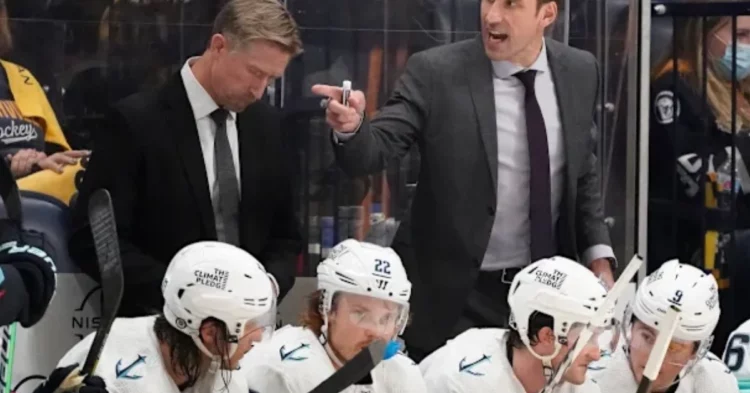
The Boston Bruins are entering a new era after a disappointing and turbulent 2024-25 NHL season, and one of the biggest talking points surrounding the franchise is the future of assistant coach Jay Leach. While many expected sweeping changes after the Bruins struggled defensively and failed to meet expectations, reports now suggest that Leach almost did not remain with the organization for the upcoming 2025-26 campaign.
According to insider David Pagnotta of The Sheet, Leach’s position on Marco Sturm’s newly assembled coaching staff was far from guaranteed. The revelation has sparked debate among Bruins fans, many of whom are still frustrated by the team’s defensive breakdowns over the last two seasons. Although Leach ultimately stayed with the club, the fact that his future was uncertain highlights how much pressure currently exists inside the Bruins organization.
Marco Sturm’s arrival as head coach already signaled major change in Boston. The former Bruins forward wasted little time putting together his own staff, bringing in veteran assistant Steve Spott as one of his key additions. That move naturally created questions about which members of the previous coaching regime would survive the transition.
Leach and Chris Kelly eventually became the holdovers from the Jim Montgomery and Joe Sacco era, but Pagnotta’s report suggests the decision regarding Leach may have been much closer than many realized.
The Bruins Entered a Critical Offseason Following Defensive Failures
Boston’s disappointing performance in 2024-25 forced the organization to reevaluate nearly every aspect of the team. While injuries and roster inconsistency certainly played a role in the club’s struggles, the Bruins’ defensive play became one of the biggest concerns throughout the season and especially during the playoffs.
The Bruins were once known for disciplined defensive hockey, structured systems, and elite goaltending support. However, those strengths seemed to disappear at critical moments over the last two years. Defensive coverage mistakes, poor gap control, inconsistent breakout execution, and communication breakdowns repeatedly hurt the team in high-pressure situations.
As the defensive coach, Jay Leach naturally became one of the figures under scrutiny.
Even though hockey is ultimately a team effort and responsibility extends beyond one assistant coach, many fans and analysts viewed Boston’s defensive collapse as evidence that changes were necessary behind the bench. The Bruins often looked disorganized in transition, struggled to contain speed through the neutral zone, and failed to consistently protect high-danger scoring areas.
Those problems became even more noticeable during postseason play, where disciplined defensive systems often determine whether a team survives or gets eliminated.
Jay Leach’s Long History With the Bruins Organization
Despite recent criticism, Jay Leach has deep roots within the Bruins organization. His coaching journey in Boston began long before he joined the NHL staff during the 2024-25 season.
Leach first became part of the organization in 2016 and quickly established himself as a respected developmental coach. He spent four seasons as head coach of the Providence Bruins in the American Hockey League, helping develop several young players who eventually reached the NHL roster.
During his time in Providence, Leach built a reputation for strong communication skills and player development. Many prospects flourished under his guidance, and he was frequently viewed as a future NHL head coaching candidate. His calm demeanor, modern coaching style, and ability to connect with younger players made him highly respected throughout hockey circles.
Because of that success, Leach’s name often surfaced whenever discussions about Boston’s future coaching plans emerged. Many inside the organization viewed him as a potential NHL coach in waiting.
However, before that opportunity materialized in Boston, Leach accepted a new challenge with the Seattle Kraken expansion franchise.
Seattle Kraken Opportunity Elevated Jay Leach’s NHL Reputation
When the Seattle Kraken entered the NHL, the expansion team sought respected coaches capable of helping build a new culture from the ground up. Jay Leach became one of the organization’s assistant coaches, joining Dave Hakstol’s staff during the franchise’s formative years.
The move allowed Leach to gain valuable NHL-level experience while expanding his reputation across the league. Working with an expansion franchise is uniquely challenging because coaches must establish systems, create chemistry among unfamiliar players, and develop a competitive identity almost immediately.
Leach spent three seasons in Seattle, helping the Kraken evolve from an expansion team into a playoff contender. During that time, his profile as an NHL coaching candidate continued to grow.
Many around the league believed it was only a matter of time before Leach either earned a head coaching opportunity or returned to Boston in a larger role.
Eventually, the Bruins brought him back into the organization for the 2024-25 season, where he finally joined the NHL coaching staff many believed he was destined to be part of years earlier.
Expectations Were High When Leach Returned to Boston
When Leach returned to Boston, expectations were substantial. His successful work in Providence, combined with his NHL experience in Seattle, created optimism that he could help modernize and stabilize the Bruins’ defensive structure.
At the time, Boston was attempting to remain competitive while transitioning into a slightly younger roster. Veteran leadership still existed, but the team also needed developmental guidance for emerging players adjusting to larger responsibilities.
Leach seemed like an ideal fit for that challenge.
However, the results never fully matched the expectations.
The Bruins experienced inconsistency throughout his tenure on the NHL bench. Defensive structure often broke down against faster teams, and the club struggled to maintain the level of reliability that previously defined Boston hockey.
While not every issue fell directly on Leach, assistant coaches are frequently judged by the specific areas they oversee. In this case, Boston’s defensive performance became difficult to ignore.
Fans became increasingly vocal as mistakes piled up, particularly during critical stretches of the season and in playoff situations where defensive execution became even more important.
Marco Sturm Faces Pressure to Reshape Bruins Identity
Marco Sturm’s hiring as head coach represents more than a simple leadership change. It signals Boston’s attempt to redefine its identity after a frustrating period of underachievement.
As a former Bruins player, Sturm understands the expectations attached to the franchise. Boston fans demand disciplined, hard-working hockey built around defensive accountability and physical competitiveness. Any coach entering the organization knows those standards are non-negotiable.
That reality likely influenced Sturm’s staffing decisions.
Bringing in Steve Spott demonstrated Sturm’s desire to add trusted voices with NHL experience. At the same time, retaining certain members of the previous staff may have been viewed as important for continuity and player relationships.
Leach ultimately survived those changes, but Pagnotta’s report suggests his margin for error may now be extremely small heading into the 2025-26 season.
If Boston’s defensive struggles continue, fans will almost certainly renew calls for additional coaching changes.
Could the Toronto Maple Leafs Pursue Jay Leach in the Future?
One of the more intriguing aspects of Pagnotta’s report involved the possibility that the Toronto Maple Leafs could eventually view Leach as a coaching candidate.
Although Craig Berube currently remains behind Toronto’s bench, NHL coaching situations can change quickly. Organizations are constantly evaluating future options, especially younger coaches with developmental experience and modern tactical approaches.
Leach’s name continues to hold respect around the league despite Boston’s recent struggles. His previous success in Providence and Seattle still carries weight among NHL executives.
For Toronto, a coach like Leach could potentially represent an appealing long-term option if the organization ever decides to move in a different direction. The Maple Leafs have consistently searched for coaches capable of balancing player development, defensive structure, and playoff performance.
Leach’s profile aligns with many of those qualities, even if Bruins fans currently have mixed feelings about his work in Boston.
That contrast highlights an important reality in professional sports: perception often depends heavily on recent results and organizational context.
Bruins Fans Remain Divided About Jay Leach’s Future
Among Bruins supporters, opinions regarding Jay Leach are clearly divided.
Some fans believe he deserves additional time under Marco Sturm’s leadership. They argue that coaching instability can create further problems and point out that roster limitations, injuries, and inconsistent player execution contributed significantly to Boston’s struggles.
Others believe the Bruins need entirely fresh defensive ideas.
Critics argue that the defensive system became predictable, passive, and ineffective against faster opponents. They believe retaining Leach risks repeating the same structural problems that hurt the team over the past two seasons.
This divide reflects broader uncertainty surrounding the Bruins’ direction as a franchise.
Boston is no longer the dominant powerhouse that consistently overwhelmed opponents with elite structure and veteran depth. The team is attempting to navigate a difficult transition period while still remaining competitive in a demanding Eastern Conference.
That balancing act places enormous pressure on the coaching staff.
The 2025-26 Season Could Define Jay Leach’s NHL Coaching Future
For Jay Leach, the upcoming season may become one of the most important years of his coaching career.
If the Bruins rebound defensively under Marco Sturm and reestablish themselves as a disciplined playoff contender, Leach could restore much of the momentum that once made him a highly regarded coaching prospect.
Strong defensive improvement would likely quiet critics while reopening conversations about future head coaching opportunities elsewhere in the league.
However, if Boston continues struggling in its own zone, criticism will intensify rapidly.
Fans have already shown frustration with the team’s recent defensive identity, and another disappointing season could force the organization to make further changes behind the bench.
The NHL is an unforgiving environment for coaches, particularly in markets with championship expectations like Boston. Success can quickly elevate reputations, while failure often leads to rapid turnover.
Leach understands those realities better than most.
Why the Bruins’ Defensive System Will Be Closely Watched This Season
One of the biggest storylines entering the 2025-26 season will be how Boston’s defensive structure evolves under Marco Sturm and Jay Leach.
The Bruins need to improve in several key areas, including defensive zone coverage, transition defense, penalty killing consistency, and puck management under pressure. Those elements are essential for any team hoping to compete deep into the playoffs.
Boston also faces the challenge of adapting to a faster NHL landscape. Teams across the league increasingly emphasize speed, aggressive forechecking, and quick puck movement. Defensive systems must evolve accordingly.
If the Bruins can successfully modernize while maintaining physicality and discipline, the coaching staff could silence many current concerns.
But if the same weaknesses continue appearing night after night, scrutiny surrounding Leach’s role will only grow stronger.
Fresh Ideas or Stability: What Is Best for the Bruins?
The central debate surrounding Jay Leach ultimately comes down to one question: should the Bruins prioritize continuity or fresh ideas?
Supporters of continuity argue that constant coaching changes rarely solve deeper roster and organizational issues. They believe players also bear responsibility for execution and that stability could help the Bruins develop stronger chemistry moving forward.
Meanwhile, those favoring change believe fresh systems and new defensive philosophies are necessary to help Boston evolve.
There is merit to both perspectives.
The NHL frequently shows examples where coaching continuity eventually produces success after difficult transitions. At the same time, some organizations only improve after making bold changes and introducing entirely new approaches.